
Nonoko And The Thief – A Zen Buddhist Spiritual Story by Anthony de Mello
There was an old Zen master called Nonoko who lived alone in a hut at the foot of a mountain. One night while Nonoko was sitting in meditation, a stranger broke into the hut and, brandishing a sword, demanded Nonoko’s money.
Nonoko did not interrupt his meditation while he addressed the man:
“All my money is in a bowl on the shelf up there. Take all you need, but leave me five yen. I have to pay my taxes next week.”
The stranger emptied the bowl of all the money it held and threw five yen back into it. He also helped himself to a precious vase he found on the shelf.
“Carry that vase with care,” said Nonoko. “It will crack easily.”
The stranger looked around the small barren room once more and was going to leave.
“You haven’t said thank you,” said Nonoko.
The man said thank you and left. The next day the whole village was in turmoil. Many people claimed they had been robbed. Someone noticed the vase missing from the shelf in Nonoko’s hut and asked if he, too, had been the victim of the burglar.
“Oh, no,” said Nonoko. “I gave the vase to a stranger, along with some money. He thanked me and left. He was a pleasant enough sort of fellow, but a bit careless with his sword!”
This is from The Heart of the Enlightened, a book of spiritual stories by Anthony de Mello.
The Spiritual Moral / Meaning of This Story
The story of Nonoko, the Zen master, presents profound lessons on detachment, generosity, and the nature of true wealth. Nonoko’s calm and composed demeanor in the face of a threatening situation reveals deep spiritual wisdom and offers several insights into living a life rooted in mindfulness and inner peace.
The first lesson is about detachment from material possessions. Nonoko’s reaction to the stranger’s demand for money and his taking of the vase illustrates a complete lack of attachment to physical objects. Nonoko’s focus remains on his meditation, undisturbed by the loss of material goods. This teaches us the importance of cultivating a sense of detachment from our possessions, recognizing that true wealth lies not in what we own but in our inner state of being.
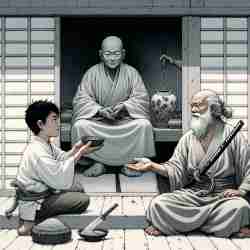 Another moral of the story concerns generosity and the practice of giving without expectation. Nonoko not only gives the thief his money but also offers advice on handling the vase with care. He even prompts the stranger to express gratitude. This demonstrates an advanced level of generosity, where the act of giving is performed with kindness and consideration for the receiver. Nonoko’s behavior encourages us to practice selfless giving and to see acts of generosity as opportunities for positive interaction, even in challenging circumstances.
The story also highlights the power of mindfulness and presence. Nonoko remains fully present and mindful throughout the encounter, addressing the stranger without fear or anger. His ability to maintain his meditation and respond thoughtfully to the situation reflects a deep state of inner peace and mindfulness. This teaches us the value of staying grounded and present, no matter what external events may occur.
Furthermore, Nonoko’s interaction with the stranger reveals the essence of true wealth. Despite being robbed, Nonoko perceives the event as an opportunity to practice his principles and to engage with the stranger in a meaningful way. His wealth is not measured by his possessions but by his equanimity and wisdom. This perspective encourages us to reconsider our definitions of wealth and to prioritize inner qualities over material accumulation.
Nonoko’s calm acceptance and positive framing of the situation also illustrate the importance of perspective. While others in the village see themselves as victims of theft, Nonoko views his experience as an act of giving. His attitude transforms a potentially negative event into a demonstration of his values and principles. This teaches us the power of perspective in shaping our experiences and the importance of maintaining a positive outlook.
The story also speaks to the nature of gratitude and the importance of acknowledging kindness. Nonoko’s insistence that the stranger say thank you, despite the circumstances, reinforces the practice of gratitude. It highlights that gratitude can be cultivated even in unexpected and difficult situations. This encourages us to find moments of gratitude in our daily lives, regardless of external conditions.
Lastly, the story imparts a lesson on the nature of true security. Nonoko’s security does not come from his possessions or the physical safety of his hut but from his inner peace and wisdom. His unshakable calm in the face of potential danger shows that true security is found within, through a deep connection to one’s spiritual practice and principles. This teaches us to seek inner strength and stability rather than relying solely on external factors.
Personal Reflection Questions:
Spiritual stories are an opportunity to reflect on your own life. Here are 10 questions you can use to go deeper with the teachings in this story:
- How attached am I to my material possessions, and how would I react if they were taken from me?
- In what ways can I practice generosity without expecting anything in return?
- How can I cultivate mindfulness and presence in my daily life, especially during challenging situations?
- What are the qualities that I consider to be my true wealth, beyond material possessions?
- How do I perceive and respond to negative events, and how can I shift my perspective to see them more positively?
- How often do I practice gratitude, and in what ways can I incorporate more gratitude into my life?
- What steps can I take to develop a deeper sense of inner security and peace?
- How do I handle interactions with others, especially when they are not acting kindly or fairly?
- In what ways can I practice detachment and embrace the impermanence of life?
- How can I use my spiritual practice to remain calm and centered in the face of adversity?
A Poem Based On This Story
The Gift of Detachment: True Wealth Within
In a hut beneath the mountain’s shade,
A Zen master in stillness stayed,
A stranger came with sword in hand,
To take what he could not command.
“All my money’s in a bowl,” he said,
“Take what you need, leave five instead,
For taxes come, I must prepare,”
The stranger took with little care.
He found a vase of value rare,
“Carry it with care,” said Nonoko there,
The stranger turned to leave the place,
“No thanks?” the master asked with grace.
The next day came, the village stirred,
Of theft and loss, their voices heard,
But Nonoko, with calm reply,
“I gave the vase, he said goodbye.”
For wealth is not in gold or land,
But in the heart, the giving hand,
The master knew what others missed,
True wealth is found in moments kissed.
By acts of kindness, presence pure,
In letting go, in hearts secure,
So learn from Nonoko, be wise,
Detach, give freely, and realize.
That life’s true riches lie within,
In simple acts, where love begins,
For in the end, it’s how we live,
In peace, in grace, in what we give.