DBT Crash Course for Clinicians – Free Training with Alexa (Lexi) Mulee
Dialectical Behavior Therapy offers clinicians a structured, skills-based approach to helping clients work with intense emotions, distress, communication challenges, and patterns that can interfere with daily life.
DBT Crash Course for Clinicians: 15 Core Techniques to Improve Emotional Regulation, Manage Distress and More brings together practical DBT foundations and more than a dozen core techniques with Lexi Mulee, LMHC, C-DBT.
You’ll explore mindfulness, distress tolerance, emotional regulation, interpersonal effectiveness, validation, culturally adapted practices, and ways to integrate DBT skills into individual work or skills groups.
The training is designed to connect DBT concepts with clinical application, giving you concrete exercises and frameworks you can evaluate for use with the clients and settings you serve.
Why Attend “DBT Crash Course for Clinicians: 15 Core Techniques to Improve Emotional Regulation, Manage Distress and More”
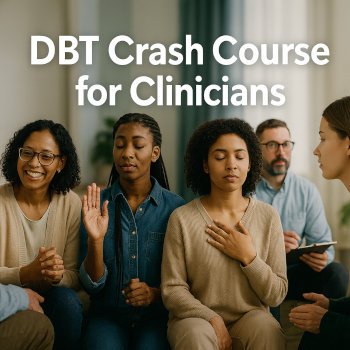
DBT combines acceptance- and change-oriented strategies with concrete skills clients can practice. This training focuses on the model’s foundations while showing how core tools can be introduced in everyday clinical work.
You’ll review techniques for emotional regulation, distress tolerance, mindfulness, validation, communication, and boundary setting, along with ways to interrupt automatic or self-defeating patterns.
The training also addresses clinical considerations such as DBT skills work with suicidal clients, treatment risks and limitations, culturally adapted interventions, and integration into a provider’s usual approach to care.
Who Should Attend
This training is designed for professionals who work in mental health settings and want a practical introduction to core DBT concepts, skills, and clinical applications.
It may be especially useful for clinicians who are new to DBT, as well as those who want to sharpen how they teach and apply DBT skills across a diverse caseload.
- Counselors
- Social workers
- Psychiatrists
- Addiction counselors
- Marriage and family therapists
- Therapists
- Physicians
- Chaplains and clergy
- Nurses
- Other professionals who work within mental health fields
What You’ll Learn
You’ll begin with DBT’s foundations, including its main goals, core practice components, four modules, and the balance between acceptance and change.
From there, the training moves into hands-on skills for mindfulness, distress tolerance, emotional regulation, interpersonal effectiveness, and validation, with attention to how these approaches can support therapeutic rapport and clinical decision-making.
You’ll also examine broader clinical considerations, including how DBT may be used with people experiencing anxiety, depression, substance use disorders, self-directed violence, and other complex presentations.
- How “wise mind” can support decision-making and problem solving
- Mindfulness exercises for present-moment awareness, stress management, and emotional regulation
- Riding the Wave, Radical Acceptance, STOP, TIPP, and ACCEPTS techniques for working with distress
- Exercises that strengthen emotional awareness and recognition
- Opposite Action and Checking the Facts skills for working with emotional responses and assumptions
- Validation strategies that can support therapeutic rapport
- DEARMAN and assertiveness skills for communication and boundary setting
- Alternate Rebellion for clients who struggle with oppositional behavior
- Considerations for skills groups, culturally adapted DBT interventions, and integrating DBT into treatment as usual
Event Schedule
The training is organized around seven connected areas, moving from DBT foundations into specific skills and then into broader clinical application.
Each section builds on the previous material so you can see how individual techniques fit within a larger DBT framework.
The program closes with case studies and demonstrations that bring the concepts together in applied clinical examples.
Foundations, Mindfulness, Distress & Emotional Regulation
- DBT Foundations and FundamentalsGoals and history, practice components, the four modules, acceptance and change, validation, indications, contraindications, limitations, treatment risks, and alternative treatments
- DBT Mindfulness TechniquesWise mind, One Mindful, Pocket Mindfulness, acceptance, and reducing self-judgment and criticism
- Five DBT Techniques to Manage Distress and Shift PerspectivesRiding the Wave, Radical Acceptance, STOP, TIPP, and ACCEPTS
- The DBT Toolkit for Emotional Regulation and CopingPhysical sensations and emotions, emotional awareness, Opposite Action, and Checking the Facts
Interpersonal Effectiveness & Clinical Integration
- Interpersonal Effectiveness Skills for Better Communication and Boundary SettingEmotional Bank Account, DEARMAN, assertiveness, saying no, setting boundaries, and Alternate Rebellion
- Other Key Clinical ConsiderationsSkills groups, individual use, culturally adapted practices, and integrating DBT skills into treatment as usual
- Case Studies and DemonstrationsApplied examples that connect core concepts with clinical practice
About Alexa (Lexi) Mulee, LMHC, C-DBT
Alexa (Lexi) Mulee, LMHC, C-DBT, is a DBT therapist, speaker, and instructor who has worked extensively with DBT in both inpatient and outpatient care settings for almost a decade.
She is the owner and founder of Wise Mind Counseling in New York City, where her work focuses on DBT through services that include skills groups, individual sessions, treatment teams, and phone coaching.
Her areas of experience include working with people dealing with borderline personality disorder, eating disorders, and addiction. She is also the author of DBT Made Doable: A Clinician’s Guide to Teaching Skills That Stick.
Free Gifts for Attendees
“Alternate Rebellion” DBT Worksheet
- A ready-made DBT worksheet from Lexi Mulee’s book DBT Made Doable
- Designed for use with clients who push back against structure, authority, or being told what to do
- A practical resource you can incorporate into relevant clinical work
Session Slides and Handouts
- Available session materials can be saved for later reference
- Resources reinforce the skills and techniques taught in the training
- Useful for reviewing key DBT concepts after the event
Frequently Asked Questions
Select any question below to reveal the answer.
What is this training about?
Who is presenting the training?
Who is this training for?
Is registration free?
Is continuing education credit included?
What free resource is included?
Will mindfulness be covered?
Which distress-tolerance skills are included?
Will emotional regulation skills be covered?
Does the training cover communication and boundaries?
Does the training address clinical integration?
Does the training discuss diverse clinical presentations?
The contents of this website/e-mail and this event are for general informational and educational purposes only. They are not legal, tax, accounting, financial, employment, compliance, clinical, or other professional advice. Consult appropriately qualified professionals about decisions specific to your practice, jurisdiction, clients, and circumstances.
We are grateful to be of service and bring you these life-changing events free of charge. In order to do this, please note that whenever you click the links and purchase items, in most (not all) cases we will receive a referral commission. We may receive a listing fee for publishing this event.
Your support in purchasing through these links makes it possible for people in over 150 countries globally to attend these life-changing events for free. Thank you!
Join Alexa (Lexi) Mulee, LMHC, C-DBT, for a focused training in core DBT foundations, techniques, and clinical applications.
- Dec 08 2026
- 6:00 am - 2:00 pm
Local Time
- Timezone: America/New_York
- Date: Dec 08 2026
- Time: 9:00 am - 5:00 pm
More Info
- Worldwide