
The Heart of a Mouse – A Spiritual Story by Anthony de Mello
A mouse was in constant distress because of its fear of the cat. A magician took pity on it and turned it into a cat. But then it became afraid of the dog.
So the magician turned it into a dog. Then it began to fear the panther, so the magician turned it into a panther. Whereupon it was full of fear for the hunter.
At this point, the magician gave up. He turned it into a mouse again saying, “Nothing I do for you is going to be of any help because you have the heart of a mouse.”
This is from The Heart of the Enlightened, a book of spiritual stories by Anthony de Mello.
The Spiritual Moral / Meaning of This Story
In the heart of this tale lies a profound lesson on the nature of fear and the essence of true transformation. The journey of the mouse, despite its changing forms, reveals the deeper truth that external changes cannot alter an internal state of being. This story teaches us that the heart and mind must undergo their own transformation for true change to occur.
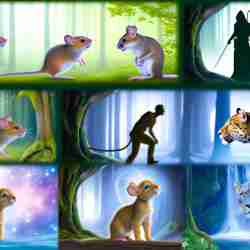 The first lesson to glean is about the nature of fear itself. Fear is not an external entity but an internal condition. No matter how much we change our surroundings or circumstances, fear will persist if we do not confront and transform it within ourselves. The mouse’s fear did not dissipate with each transformation; it merely shifted from one source to another. This teaches us that external solutions to internal problems are often futile. True courage must arise from within, independent of external factors.
Another moral of the story is about self-acceptance and the futility of wishing to be something we are not. The mouse wished to be stronger, more powerful, and less vulnerable, but each transformation only led to new fears. The lesson here is to embrace our true nature and work on strengthening our inner self rather than constantly seeking external changes to fix our insecurities. Personal growth and self-acceptance are the keys to overcoming fear.
The role of the magician is also significant. He symbolizes external aid or intervention that tries to change our state. The magician’s attempts to help the mouse failed because true change cannot be imposed from the outside. It underscores the importance of personal responsibility in one’s growth. Real transformation requires internal effort and a change of heart.
The final transformation back to a mouse and the magician’s words, “Nothing I do for you is going to be of any help because you have the heart of a mouse,” illustrate the ultimate truth that inner essence dictates outer experience. The heart of a mouse, full of fear, remained unchanged despite the physical transformations. This highlights that inner qualities such as courage, resilience, and wisdom are what truly define our experiences, not the outer appearances.
This story also speaks to the concept of authenticity. Trying to become something we are not, or relying on external transformations, often leads to a cycle of perpetual dissatisfaction and fear. Authenticity requires embracing who we truly are and working from within to cultivate the qualities we desire. By acknowledging and addressing our inner fears and limitations, we can achieve a genuine transformation that no external change can provide.
Lastly, the story imparts a lesson on the limitations of external power. The magician, despite his immense power, could not change the mouse’s inner nature. This teaches us that no matter how powerful external influences might be, true change is a personal journey that requires inner strength and self-awareness.
Personal Reflection Questions:
Spiritual stories are an opportunity to reflect on your own life. Here are 10 questions you can use to go deeper with the teachings in this story:
- What are the fears that I carry within me, and how do they manifest in my life?
- How do I typically respond to fear? Do I seek external solutions or try to address it internally?
- Have I ever sought to change my external circumstances in hopes of alleviating internal distress? What was the outcome?
- In what ways do I try to become something I am not, and what drives these desires?
- How can I practice self-acceptance and embrace my true nature more fully?
- What qualities do I need to cultivate within myself to overcome my fears?
- How do I rely on external interventions or validations for my sense of security and well-being?
- What steps can I take to strengthen my inner resilience and courage?
- How does authenticity play a role in my personal growth and transformation?
- In what ways can I take personal responsibility for my own growth and not depend on external changes to feel secure?
A Poem Based On This Story
The Heart of Transformation: True Courage Lies Within
In a world where fear holds tight,
A mouse in shadows, full of fright,
Wished for strength, to change its fate,
But fear within would not abate.
A wizard’s hand, with magic bold,
Turned mouse to cat, a tale retold,
But fear of dog soon took its place,
A frightened heart in each new face.
From cat to dog, the change was swift,
Yet fear remained, an endless rift,
To panther then, with strength and might,
But hunter’s shadow brought new fright.
The wizard sighed, his efforts vain,
For fear had rooted, caused the pain,
“Back to a mouse,” the wizard said,
“For in your heart, true fear is bred.”
No form or shape can change the core,
If fear resides, it haunts much more,
A lesson deep in tale so quaint,
True courage lies within, not paint.
Accept your heart, your nature true,
Transform within, let fear undo,
For magic lies in self-embrace,
A fearless heart in any place.