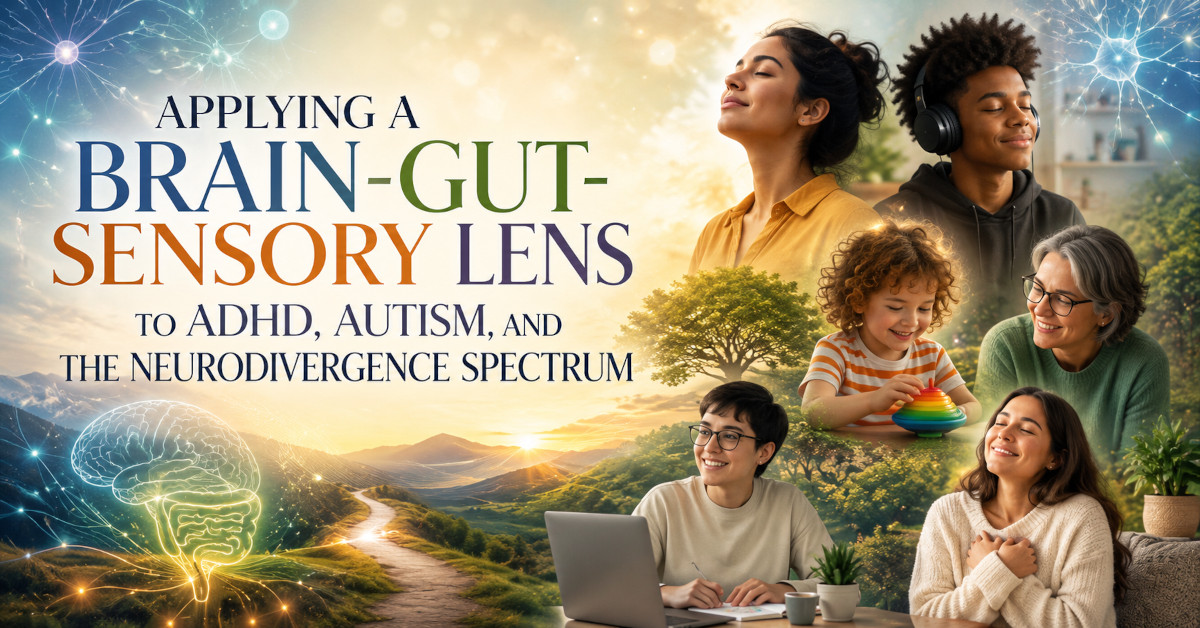
Applying a Brain-Gut-Sensory Lens to ADHD, Autism, and the Neurodivergence Spectrum – Free Training with BG Mancini
A person may communicate clearly, regulate emotions, and manage daily demands in one setting, then struggle to access those same capacities later. When those shifts are viewed only as behavior, important sensory, physiological, and environmental influences can be missed.
This free webinar with BG Mancini introduces a Brain-Gut-Sensory Framework for exploring what may be influencing a person’s capacity in the moment. The approach brings together nervous system state, sensory processing, sleep, physiology, environmental conditions, and the brain-gut connection.
You will examine why attention, communication, flexibility, emotional regulation, executive functioning, and daily capacity may fluctuate. You will also learn practical ways to recognize patterns and consider supportive adjustments in clinical work and everyday settings.
The presentation offers general education rather than a single explanation or prescriptive solution. Its purpose is to support more curious, compassionate, and systems-informed decisions when working with neurodivergent individuals and families.
Why Attend “Applying a Brain-Gut-Sensory Lens to ADHD, Autism, and the Neurodivergence Spectrum”
Changes in communication, attention, emotional regulation, flexibility, and executive functioning can appear inconsistent when the wider context is not considered. Sensory experiences, nervous system state, sleep, physiology, the environment, and brain-gut communication may all contribute to what a person can access at a particular time.
This webinar matters because explanations focused only on behavior can overlook the interconnected systems shaping lived experience. BG Mancini presents a broader framework for asking what may be influencing capacity rather than assuming that a difficult moment reflects unwillingness, lack of effort, or a fixed ability.
The session may help clinicians and other helping professionals notice patterns, ask more informed questions, and consider practical forms of support. It does not provide a universal explanation, but it offers a structured way to approach neurodivergent experiences with greater curiosity and compassion.
Who Should Attend
This webinar is designed for clinicians and helping professionals who support children, adolescents, adults, or families affected by ADHD, autism, AuDHD, or other neurodivergent experiences. It may be useful when communication, regulation, behavior, or daily capacity appears to change across environments or from one day to another.
The material may support professionals who want to integrate sensory, physiological, environmental, and nervous system considerations into their thinking. It is general education and should be applied within each participant’s training, professional scope, and relevant clinical requirements.
- Therapists supporting neurodivergent children, adolescents, or adults
- Clinicians working with ADHD, autism, or AuDHD
- Professionals exploring sensory processing and nervous system regulation
- Practitioners seeking a broader context for changes in daily capacity
- Helping professionals supporting communication and executive functioning
- Providers working with neurodivergent individuals and their families
- Clinicians interested in brain-gut and physiological influences
- Professionals looking for practical, systems-informed educational strategies
What You’ll Learn
During the webinar, you’ll explore how brain, body, sensory, microbial, environmental, and nervous system influences may interact with moment-to-moment capacity. This wider view can provide useful context when a person’s access to skills and strengths changes.
You’ll also consider how sleep, inflammation, sensory processing, the gut microbiome, and brain-gut communication may relate to attention, emotional regulation, communication, behavior, and executive functioning. Rather than treating one factor as the complete explanation, the framework emphasizes patterns across interconnected systems.
Along the way, BG will introduce practical MicroResets™ and educational strategies that may be integrated into therapy settings and everyday life. The emphasis remains on observation, appropriate support, and adapting ideas responsibly to the needs and circumstances of each person.
- Why communication, regulation, flexibility, and daily capacity may fluctuate
- How nervous system state may affect access to established skills
- Ways sensory experiences and environmental conditions can shape capacity
- How sleep and physiological factors may influence lived experience
- Why brain-gut communication and the gut microbiome may be relevant
- How to recognize patterns that may be overlooked when focusing only on behavior
- Ways naming possible influences may support understanding and agency
- Environmental and sensory modifications that may reduce physiological load
- Practical MicroResets™ and educational strategies for everyday application
- How to use the Brain-Gut-Sensory Framework as a compassionate inquiry tool
Event Schedule
The webinar is scheduled for Monday, August 10, 2026. The live presentation runs for 90 minutes.
Monday, August 10, 2026
- Applying a Brain-Gut-Sensory Lens to ADHD, Autism, and the Neurodivergence SpectrumBG Mancini, AP, FMP, MS — 9:00-10:30am PST
About BG Mancini, AP, FMP, MS
BG Mancini is a Neurodevelopmental Specialist who is Advanced Certified in Functional Medicine. She has also been licensed as an Acupuncture Physician and Primary Care Provider since 2013.
She is the founder of The Brain & Gut Institute and the creator of The Family Nervous System®, a model that considers the family as an interconnected living system rather than focusing only on one individual.
BG brings nearly 30 years of clinical experience to her work. She has worked with more than 7,000 patients and trained over 600 clinicians using approaches that integrate biomedical, nervous system, and neurodevelopmental perspectives.
As an international speaker and trainer, she brings together Polyvagal Theory, brain-gut axis research, and sensory and neurodevelopmental science. Her teaching focuses on making complex concepts practical for clinicians seeking to understand the physiological influences behind experiences often described primarily as behavior.
Frequently Asked Questions
Select any question below to reveal the answer.
When and where does the webinar take place?
Who is BG Mancini?
What will I learn during the webinar?
What if I cannot attend live?
How long is the webinar?
Do I need any special equipment to participate?
Who is hosting the webinar?
Is this webinar suitable for newer clinicians?
Who is this webinar for?
Does the webinar offer continuing education credit?
Is this event really free?
Will there be breaks during the webinar?
Is this a treatment program?
What is the Brain-Gut-Sensory Framework?
Does the webinar cover ADHD, autism, and AuDHD?
Will sensory processing be discussed?
Will the gut microbiome and inflammation be covered?
What are MicroResets™?
Will I learn about environmental modifications?
Can I apply this framework in clinical practice?
Does the framework replace medical or clinical assessment?
The contents of this website/e-mail and this event are for general informational and educational purposes only. They are not legal, tax, accounting, financial, employment, compliance, clinical, or other professional advice. Consult appropriately qualified professionals about decisions specific to your practice, jurisdiction, clients, and circumstances.
We are grateful to be of service and bring you these life-changing events free of charge. In order to do this, please note that whenever you click the links and purchase items, in most (not all) cases we will receive a referral commission. We may receive a listing fee for publishing this event.
Your support in purchasing through these links makes it possible for people in over 150 countries globally to attend these life-changing events for free. Thank you!
Join BG Mancini for a practical introduction to the sensory, physiological, environmental, and nervous system influences that may shape neurodivergent experiences.
- Aug 10 2026
- Expired!
- 9:00 am - 10:30 am
Local Time
- Timezone: America/New_York
- Date: Aug 10 2026
- Time: 12:00 pm - 1:30 pm
More Info
- Worldwide
Organizer

-
The Academy of Therapy Wisdom
-
Website
https://spiritualgrowthevents.com/somatic-grief-work