
The Devoted Wife
Champeyya, the serpent king, was actually a reincarnation of the Bodhisattva. He married a beautiful serpent princess called Sumana and led a happy life. However, he soon grew tired of his life of luxury and went to the forest to meditate, leaving his wife behind.
One day, while he was sitting on an anthill deep in meditation, a snake charmer saw him and trapped him with the help of his magical powers. The serpent king was then made to dance on the streets to the tunes of the snake charmer’s flute.
Meanwhile, his devoted wife went from town to town looking for her husband and at last saw him dancing in the royal court of Benaras. Champeyya stopped his dance at the sight of his tearful wife.
Sumana freed her husband with the help of the king and took him home.
The author of this story is unknown and greatly appreciated!
The Spiritual Moral / Meaning of This Story
The story of Champeyya, the serpent king, and his devoted wife Sumana is rich with spiritual themes that explore the nature of attachment, the power of devotion, and the journey towards enlightenment. Through their experiences, we are invited to reflect on the deeper meanings of commitment, liberation, and the pursuit of spiritual goals.
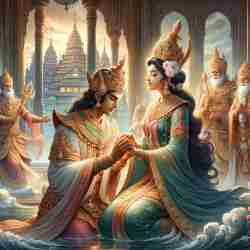 Detachment and Renunciation: Champeyya’s decision to leave his life of luxury and his wife behind to meditate in the forest illustrates the theme of renunciation, a common motif in spiritual traditions. This act signifies the pursuit of higher spiritual goals over worldly pleasures and attachments. Champeyya’s journey into the forest represents a step towards self-discovery and enlightenment, highlighting the importance of detachment from material comforts in the quest for spiritual growth.
The Power of Devotion: Sumana’s unwavering devotion to her husband is a powerful element of the story. Despite Champeyya’s departure, her love and commitment do not wane. Her relentless search for him symbolizes the strength and purity of true devotion. This aspect of the story underscores the spiritual principle that sincere devotion and love can overcome great obstacles and bring about liberation.
Suffering and Liberation: Champeyya’s capture by the snake charmer and his subsequent forced performances symbolize the suffering and bondage experienced in the material world. His plight as a dancing serpent highlights the loss of freedom and the painful consequences of being entangled in worldly affairs. However, the story also shows that liberation is possible through perseverance, devotion, and the intervention of compassionate forces, represented by Sumana and the king.
The Role of Compassion: The involvement of the king in freeing Champeyya demonstrates the role of compassion and righteousness in the process of liberation. The king’s willingness to help Sumana and Champeyya reflects the spiritual virtue of compassion, emphasizing that acts of kindness and justice are essential in supporting others on their spiritual journey.
Unity and Balance: The reunion of Champeyya and Sumana signifies the restoration of balance and harmony. While Champeyya’s initial renunciation was necessary for his spiritual growth, the story ultimately brings him back to his devoted wife, suggesting that true enlightenment involves a balance between renunciation and engagement with the world. It implies that spiritual progress does not necessarily require complete withdrawal from worldly relationships but can be achieved through integrating spiritual practices into everyday life.
Symbolism of the Serpent: The serpent, often associated with transformation and rebirth in various cultures, symbolizes the potential for spiritual evolution. Champeyya’s experiences as the serpent king reflect the cycles of suffering and liberation, reinforcing the idea that through trials and tribulations, one can attain higher spiritual states.
Endurance of the Soul: The Bodhisattva’s reincarnation as Champeyya and his journey through suffering to eventual liberation highlight the enduring nature of the soul. The story suggests that the soul’s journey towards enlightenment continues across different lifetimes, with each experience contributing to its ultimate realization.
In essence, the story of Champeyya and Sumana is a profound narrative that explores the themes of renunciation, devotion, compassion, and the enduring journey of the soul towards enlightenment. It teaches that true spiritual progress involves both detachment from material bonds and a deep commitment to love, compassion, and justice.
Personal Reflection Questions:
Spiritual stories are an opportunity to reflect on your own life. Here are 10 questions you can use to go deeper with the teachings in this story:
- Detachment and Renunciation: How do you balance your pursuit of spiritual goals with your attachment to material comforts and relationships? What can you learn from Champeyya’s journey about detachment?
- Power of Devotion: Reflect on a time when your devotion or commitment helped you overcome a significant challenge. How did it shape your spiritual journey?
- Suffering and Liberation: What forms of bondage or suffering do you experience in your life? How can you work towards your own liberation, inspired by Champeyya’s story?
- Role of Compassion: How do acts of compassion and kindness play a role in your spiritual practice? Can you recall a moment when someone’s compassion helped you in a difficult time?
- Unity and Balance: How do you find balance between your spiritual practices and your everyday responsibilities? What can you learn from the reunion of Champeyya and Sumana about maintaining harmony in your life?
- Transformation and Rebirth: Reflect on a period of transformation in your life. How did this experience contribute to your spiritual growth?
- Endurance of the Soul: How do you view the journey of the soul through different experiences and lifetimes? What insights do you gain from the concept of reincarnation?
- Integration of Spirituality: How do you integrate your spiritual beliefs and practices into your daily life? What challenges do you face in this integration?
- Commitment to Love: In what ways do you show your commitment to love and relationships? How does this commitment align with your spiritual values?
- Compassionate Leadership: How can you embody the role of a compassionate leader in your community or family? What lessons can you take from the king’s intervention in freeing Champeyya?
A Poem Based On This Story
The Serpent King’s Journey: A Tale of Love and Liberation
In serpent’s guise, a king once lived,
A Bodhisattva’s soul he did give,
To realms of earth, in forest deep,
Where silent vows and meditations seep.
Sumana, fair, his princess true,
In palace grand, her love she knew,
Yet Champeyya sought the sacred way,
In solitude, he chose to stay.
On anthill high, in silent trance,
A charmer came with cunning glance,
He bound the king with magic’s song,
In streets he danced, the days were long.
Through towns and courts, the serpent swayed,
To charmer’s tune, his soul betrayed,
But Sumana’s love, it never ceased,
Her heart ached for her king’s release.
With tearful eyes, she found him there,
In Benaras’ court, midst royal air,
Her presence broke his captive spell,
In love’s embrace, his chains did quell.
The king with heart, so just and kind,
Released the serpent, bonds unbind,
Together home, they made their way,
In love and peace, their hearts did stay.
From luxury to forest’s peace,
Through suffering, his soul’s release,
Champeyya’s journey, a tale of light,
From darkness deep to spirit’s height.
In serpent’s form, the lesson clear,
Of love and faith that persevere,
For in each heart, the Bodhisattva’s grace,
Guides every soul to its rightful place.