
The Old Man
Once long ago, there lived an old man.
He had no money. He had no plan.
All that he had was a horse oh so grand
and he and his horse lived off the land.
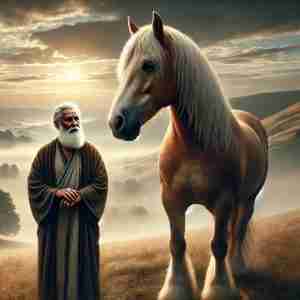 The King offered riches for this horse oh so fine,
“I’ll give you money if you’ll make your horse mine.”
But the old man said, “My horse will not be sold,
he lives with me. He lives free and bold.”
Then one day the horse was plain gone.
“The horse had been stolen,” the townsfolk cried on.
The old man said, “Friends, don’t look so sad,
Though the horse be gone that may not be so sad.”
“You foolish old man, look what you’ve done.
You had a fine horse and now you have none.
A curse it is and a curse it will be,
you shouldn’t have let your horse wander free!”
The horse soon returned with others by its side.
There were twelve now of beauty and pride.
The townsfolk said, “Old man, you were right.
You are blessed to have horses of unearthly delight!”
“I have 12 horses, yes that is true
but that does not mean I am blessed with them too.
It is too soon to judge, who knows what will be?
Try not to make stories from the little you see.”
As it came to pass, the old man’s only son
tried riding a horse, just for fun.
Yet he broke both his legs while playing this game
and the townsfolk cried, “Oh what a shame!”
The old man said, “Friends don’t speak so soon.
You hear just one note yet you sing an entire tune.
Who’s to say what the future may hold?
My son’s legs are broken but the future lies untold.”
Soon there was war, and the young men of town
were all sent to fight and were shot down.
But the old man’s son was saved from this plight.
He had broken his legs, he was forced not to fight.
And the townfolk cried out, “Again you were right!”
But the old man replied, “Have you no sight?
Only God knows what is and will be.
To live and let live is to live and live free.”
This spiritual story was written by Jonathan Robinson.
The Spiritual Moral / Meaning of This Story

Life often unfolds in unexpected ways, and our initial judgments about events can be misleading. The old man in the story exemplifies a wisdom that recognizes the limitations of human perspective. His story reminds us to resist the temptation to hastily label experiences as good or bad.
By understanding that life’s events are interconnected in ways we might not immediately grasp, we learn to cultivate patience and acceptance. Instead of being swayed by immediate circumstances, the old man invites us to see beyond the surface, acknowledging that each moment carries potential and uncertainty.
The Illusion of Certainty
The townsfolk are quick to judge the old man’s circumstances, swinging from despair to elation and back again based on the unfolding events. This reflects a common human tendency to seek certainty and to categorize experiences. The old man, however, shows us that certainty is an illusion, and our attempts to control or predict life are often misguided.
Embracing uncertainty and letting go of rigid expectations allows us to remain open to life’s unfolding. The story encourages us to trust in the greater flow of life and to find peace in the present moment, rather than being caught up in anxiety about the future or regret about the past.
Acceptance and Letting Go
Central to the story is the theme of acceptance. The old man doesn’t resist the events that occur, nor does he cling to them. Instead, he flows with life, understanding that attachment to outcomes only brings suffering. This lesson can guide us in cultivating a mindset of letting go, embracing what is without trying to control it.
Acceptance is not passive resignation but an active engagement with reality as it is. By accepting the impermanence and unpredictability of life, we find freedom from the burden of expectation and disappointment. The story encourages us to find harmony in the present, appreciating life in its entirety.
The Interconnectedness of Events
The narrative also highlights the interconnectedness of events. What seems like a loss or misfortune often leads to unforeseen blessings, and vice versa. This interconnectedness reminds us that our lives are part of a larger tapestry, and each event plays a role in the unfolding story.
Recognizing this interconnectedness encourages us to cultivate compassion and understanding for ourselves and others. It reminds us that every experience contributes to our growth and transformation, shaping us in ways we might not initially perceive.
The Wisdom of Humility
The old man’s humility is a key aspect of his wisdom. He acknowledges that he cannot see the full picture, and he refrains from making definitive judgments. This humility invites us to approach life with a sense of wonder and openness, recognizing that we are part of a vast and mysterious universe.
Humility allows us to learn from every experience and to approach life with curiosity rather than certainty. It encourages us to listen deeply to ourselves and others, honoring the diverse perspectives and experiences that enrich our journey.
Personal Reflection Questions
Spiritual stories are an opportunity to reflect on your own life. Here are 10 questions you can use to go deeper with the teachings in this story:
- How do you typically respond to unexpected events in your life? Are you quick to label them as good or bad?
- In what ways can you practice acceptance and letting go in your daily life?
- Reflect on a time when something you initially perceived as negative led to a positive outcome. How did it change your perspective?
- How does the story inspire you to embrace uncertainty and trust in the flow of life?
- What does humility mean to you, and how can it guide you in your interactions with others?
- How can recognizing the interconnectedness of events help you cultivate compassion and understanding?
- What are some ways you can remain open to life’s unfolding without being attached to specific outcomes?
- How does the story encourage you to find peace in the present moment, regardless of external circumstances?
- Reflect on a recent experience where you felt the need to control or predict an outcome. How can you approach it differently with the wisdom from this story?
- In what ways can you nurture a mindset of curiosity and wonder, allowing life’s mysteries to unfold without judgment?