
Crows and Pigeons of Mumbai
“Most people are other people. Their thoughts are someone else’s opinions, their lives a mimicry, their passions a quotation.” ~Oscar Wilde
In the city of Mumbai, there was once a rare bird, called Bugun Liocichla. This bird was one of an endangered species, with the only known population estimated to consist of 14 individuals in Mumbai. This bird had two sons who were growing up and had started asking him questions on life, on conduct, on work, and on wisdom. The bird was reputed for his wisdom among all the birds of Mumbai. He had the reputation of being an ascetic who was not concerned with material riches and was content with whatever little came his way.
One day his two sons, who were about to finish their education, asked him what profession they should choose. They told him about the popular professions that were being pursued by other birds at the time. Of all the professions being pursued by the birds of Mumbai, the professions of crow or pigeon were the most popular. Everybody wanted to become either a crow or a pigeon. It is always safer and more comfortable to do what many people are doing or seemed to want to be doing. The rare bird listened to them and said the following words:
“Two winged creatures are plentiful in the skies and grounds of Mumbai — the crow and the pigeon. The crows scavenge through the garbage and the pigeons make every building and pathway their abode. Crows are noisy and pigeons make sounds like an echoing ghost. Crows and pigeons don’t hate each other. Though they have their own interests, their motives converge into one.
Crows are the kings of garbage and pollute the air; pigeons scavenge food others provide for them — intentionally or unintentionally. Both usually make their living by feeding on and spreading disease amongst birds.
The crows are the glamorous ones — they easily come to prominence with all the noise they make. Birds like this noise and make a culture out of it. Pigeons are the ones who work stealthily, keep in the background but poison all the same. One crow is enough to generate a lot of attention but birds don’t notice pigeons unless they are in large numbers.
Crows exalt in the garbage, proclaiming it to be the ultimate, considering it to be the pinnacle of their existence. This they call fame and success. The pigeons follow them, are their fans but feed on them nonetheless. It’s a symbiotic relationship. Both need each other, both feed on each other and on others. Nevertheless, popularity and fame rest with the crows for garbage is what all the birds are attracted to these days.
The faces of these crows haunt one all the time, are ever present in front of one’s eyes, their voices always being heard in some form or other from various sources. Their language becomes the language of the birds, their voice becomes the voice of most other birds. Their acts become the acts of other birds and their thoughts become the thoughts of other birds. They act as if acting is real and indeed they proclaim this to be the real. Their followers too become actors and their lives become a series of acts. Their influence is exerted over large domains, across many seas. They attract, seduce, and captivate the minds and hearts of other birds. Their poison spreads effortlessly. They easily, swiftly and most naturally create an army of their clones.
The pigeons are ever ready to have their fill and nothing is enough for them. Saturation does not exist for them. They want more and more. They didn’t want trees, so now they have buildings made all for themselves; carefully and with determination, they have covered all space. They are the marketers — they sell and trade everything. Trade is their natural occupation. They never do anything but trade. They never possess anything that they can’t sell. Trade is their religion and selling is their life.
The skies of Mumbai are full of crows and pigeons. Indeed, they want their kingdom to expand to the farthest shores. Pigeons make tall buildings and crows have their faces painted on them. They are the rulers of the skies and the grounds. They poison, trade and sell and are bestowed with honors and fame. Their names are well known, their voices recognized, they are loaded with honors and fortune and exalt in their happy lot. Is it so surprising then, that all the other birds want to be like a crow or a pigeon?
Are you an ambitious bird? Do you know what ambition is? It is the desire to become somebody, is it not? And do you know what it does? It causes us to be against one another. Everybody is struggling to be rich, to have fame, to be more clever. You want to be greater than the other person and he wants you to be greater than you. So ambition really means trying to be something you are not. And which is important? To be what you are or try to be something you are not? You must first look at yourselves and begin to understand what you are. And then perhaps you’ll never ask what you should do.
Do not compare with what other birds are doing. Don’t try to become like them, even if everybody else becomes like them. It is hard for you because comparison is the basis of our so-called education, and of our whole culture.
Comparison is the most destructive thing in the world. If you compare yourselves with others then how can you find out what you are interested in, what your capacities are? Don’t imitate, don’t try to become like anybody else, no matter how great. It is you who are important, not somebody else. Find out who you are.”
The two boys understood what their father said. No more did they want to be a crow or a pigeon. No more did they want to become like others. No more did they want to become common.
They said to themselves, “it is better to be a rare bird than to be a well known crow or a pigeon; it is better to be an unknown than a known poisonous creature; it is better to remain obscure than to shine with artificial light.”
Ashutosh Ghildiyal is a salaried professional based in Mumbai, India. He was born in Lucknow in 1984, where he completed his schooling. He completed his graduate studies in New Delhi and his post-graduate education in Mumbai. He is the author of – To Think or Not to Think and Other stories, blogs, various articles, and short stories.
The Spiritual Moral / Meaning of This Story
This profound story about the rare bird Bugun Liocichla and his wisdom-laden advice to his sons offers deep spiritual insights into the nature of individuality, the pitfalls of conformity, and the essence of true wisdom. The narrative challenges us to look beyond societal norms and pressures, urging us to discover and embrace our unique selves.
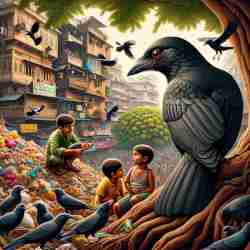 Individuality vs. Conformity: At the heart of the story is a powerful message about the importance of individuality. The rare bird Bugun Liocichla symbolizes the uniqueness and rarity within each of us. His advice to his sons underscores the dangers of conforming to societal expectations, represented by the crows and pigeons of Mumbai. These birds epitomize the majority who follow the trends and live unexamined lives. The father’s wisdom highlights that true fulfillment comes from embracing one’s uniqueness rather than mimicking others.
The Pitfalls of Ambition: The rare bird’s discourse on ambition sheds light on how it often leads to unnecessary competition and discontent. Ambition, as described in the story, is the desire to become something one is not, driven by comparison and societal pressure. This pursuit of external validation and success can lead to a life of constant striving and dissatisfaction. The story teaches us that it is more important to understand and accept who we are, focusing on our inherent qualities and interests rather than trying to outdo others.
The Illusion of Success: The crows and pigeons symbolize the illusion of success as defined by societal standards. The crows, with their noise and prominence, and the pigeons, with their stealth and trade, both represent lifestyles that are seemingly successful but ultimately hollow. These birds are driven by materialism and external validation, spreading metaphorical poison in the process. The rare bird’s wisdom reveals that true success is not about fame or wealth but about living authentically and with integrity.
The Power of Non-Comparison: One of the most profound teachings in the story is the destructive nature of comparison. The rare bird emphasizes that comparing oneself to others hinders self-discovery and personal growth. By focusing on what others are doing, we lose sight of our own potential and passions. The story advocates for self-exploration and self-acceptance, encouraging us to find out who we truly are without the influence of external benchmarks.
Wisdom and Contentment: The rare bird embodies wisdom and contentment, living a life free from the pursuit of material riches and societal approval. His contentment with whatever little comes his way contrasts sharply with the constant striving of the crows and pigeons. This teaches us that true wisdom lies in finding contentment within ourselves and living a life aligned with our values and true nature.
Authenticity Over Artificiality: The story ultimately calls for authenticity over artificiality. The rare bird’s sons realize that it is better to be a rare, unknown bird than to shine with artificial light like the crows and pigeons. This highlights the value of living a life true to oneself, even if it means remaining obscure or unnoticed by the world. Authenticity brings a deeper sense of fulfillment and peace than any external accolade can provide.
In essence, this story serves as a reminder to embrace our individuality, resist the pressures of conformity, and seek wisdom and contentment within. It encourages us to live authentically, focusing on our unique qualities and passions rather than striving to meet societal expectations. By doing so, we can find true fulfillment and live a life of integrity and purpose.
Personal Reflection Questions:
Spiritual stories are an opportunity to reflect on your own life. Here are 10 questions you can use to go deeper with the teachings in this story:
- Embracing Individuality: How do you embrace your unique qualities and strengths? What steps can you take to further discover and nurture your individuality?
- Avoiding Conformity: In what ways do you find yourself conforming to societal expectations? How can you resist these pressures and stay true to yourself?
- Understanding Ambition: Reflect on your ambitions. Are they driven by a genuine desire for growth or by comparison and societal pressure? How can you align your ambitions with your true self?
- Redefining Success: How do you define success? What changes can you make to ensure your definition of success is aligned with your values and true nature?
- The Illusion of Success: Have you ever pursued something that seemed successful by societal standards but felt hollow to you? What did you learn from that experience?
- The Danger of Comparison: How often do you compare yourself to others? How can you shift your focus from comparison to self-discovery and personal growth?
- Finding Contentment: What brings you a sense of contentment and peace? How can you cultivate more of this in your daily life?
- Living Authentically: Are there areas in your life where you feel you are not living authentically? What steps can you take to align your actions with your true self?
- Wisdom in Simplicity: How do you practice wisdom in your daily life? What simple pleasures bring you joy and fulfillment?
- Influence of Others: How much do the opinions and actions of others influence your decisions? How can you reduce this influence and focus more on your own values and desires?
A Poem Based On This Story
The Rare Bird’s Wisdom: Embracing Your True Self
In Mumbai’s skies, a bird so rare,
Lived a life beyond compare,
With wisdom deep, and vision clear,
He taught his sons a truth sincere.
“Look to the crows and pigeons, son,
Their lives, a mimicry, have begun,
In garbage heaps and buildings tall,
They find their fame, they heed the call.”
“Crows, with noise and presence grand,
Claim their kingdom in this land,
While pigeons trade and multiply,
In shadows, unseen, they vie.”
“Their lives, a cycle, poison spread,
In fame and trade, their souls are led,
Yet in their clamor, they lose sight,
Of true wisdom, hidden light.”
“Ambition drives them, blind and fast,
To be someone, to outlast,
But in this race, they lose their way,
Their true selves, they betray.”
“Comparison, the thief of peace,
In its grip, their joys decrease,
For in the mirror of others’ gaze,
They lose themselves in a daze.”
“Find your path, my sons so dear,
In your own heart, let it appear,
For true success is found within,
In simple joys, let life begin.”
“Do not seek the crows’ loud fame,
Or pigeons’ trade in endless game,
But in your uniqueness, stand tall,
Live authentically, heed the call.”
“For in the world, there’s none like you,
Your path, your light, your sky so blue,
Embrace your rarity, your grace,
And find your joy in your own space.”
With these words, the sons did see,
The wisdom in their father’s plea,
No longer did they seek the crowd,
In their own way, they stood proud.
In Mumbai’s skies, a bird so rare,
Taught us all, with wisdom’s care,
To live our truth, to be our own,
And in our hearts, find our home.