
The Poor Man’s Hut – A Sufi Spiritual Story by Osho
The man who learns the art of sharing is the richest man in the world. He may be poor, but his inner being has a quality of richness that even emperors may feel jealous of.
I have always loved a small Sufi story: A poor man, very poor, a woodcutter, lived in the forest in a small hut. The hut was so small that he and his wife could sleep …only that much space was in the hut.
In the middle of one dark night, it was raining hard and somebody knocked on the door. The wife was sleeping close to the door. The husband said to the wife, “Open the door. The rain is too much and the man must have lost his way. It is a dark night and the forest is dangerous and full of wild animals. Open the door immediately!”
She said, “But there is no space.” The man laughed and said, “This is not a palace of a king, where you will always find a shortage of space. This is a poor man’s hut. Two can sleep well; three can sit. We will create space. Just open the door.”
And the door was opened. The man came in and he was very grateful and they all sat and started talking and gossiping and telling stories to each other. The night had to be passed somehow because they could not sleep; there was no space. And just then, another knock ….
The man, the new guest, was now sitting by the side of the door. The owner of the hut said, “Friend, open the door. Somebody else is lost.” And the man said, “You seem to be a very strange fellow. There is no space.”
He said, “This was my wife’s argument too. If I had listened to her argument, you would have been in the forest, eaten by the wild animals. And you seem to be a strange man that you cannot understand that we are sitting just because of you. We are tired after a long day. I am a woodcutter — the whole day I cut the wood and then sell it in the market and then we can hardly get food once a day. Open the door. This is not your hut. If three persons can sit comfortably, four persons can sit a little closer, with a little less comfort. But we will create the space.”
Naturally he had to open the door, although reluctantly. And a man entered and he was very grateful. Now they were sitting very close; there was not even a single inch of space left. And then suddenly, a strange knock, which did not seem to be a man’s! There was silence from all three; the wife and the two guests were afraid that he would say open the door.
And he said it. “Open the door. I know who is knocking. It is my donkey. In this wide world he is my only friend. I carry my wood on that donkey. He remains outside, but it is raining too much. Open the door.”
And now it was the fourth guest to be allowed in, and everybody resisted and they said, “This is too much. Where is the donkey going to stand?”
This man said, “You don’t understand. It is a poor man’s hut, it is always spacious. Right now we are sitting; when the donkey comes in we will all be standing and we will
keep the donkey in the middle so he feels warm and cozy and loved.”
They said, “It was better to get lost in the jungle, rather than to be caught in your hut.”
But nothing could be done. When the owner said to open the door, the door was opened.
And the donkey came in. The water was dripping from all over his body and the owner took him into the middle and told all the others to stand around. He said, “You don’t understand. My donkey is of a very philosophical mind. You can say anything, he is never disturbed. He always listens silently.”
Osho – “Bodhidharma : The Greatest Zen Master”
If you liked this story, you’ll love this! We’ve compiled a list of the favorite spiritual stories that our readers love.
The Spiritual Moral / Meaning of This Story
The tale of the woodcutter and his humble hut offers a profound lesson on the nature of true wealth, compassion, and the art of sharing. Through this story, we are reminded that the greatest richness comes not from material possessions but from the generosity of spirit and the willingness to share what little we have with others.
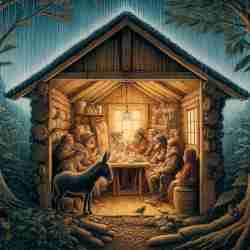 The woodcutter’s immediate response to the first knock on the door reflects his deep sense of empathy and responsibility. Despite his own poverty, he cannot ignore the plight of another person lost in the dangerous, dark forest. His readiness to welcome a stranger into his cramped home signifies a heart that values human life and connection above personal comfort. This act of kindness illustrates that true wealth lies in our capacity to give and support each other, especially in times of need.
The argument with his wife about the lack of space further highlights a common human concern—self-preservation. Yet, the woodcutter’s laughter and his decision to create space where none seems to exist shows his understanding that generosity transcends physical limitations. This moment underscores that the spirit of sharing is not bound by the constraints of material reality; instead, it flourishes in the willingness to include others in our lives, even when it requires personal sacrifice.
When the second guest arrives and the woodcutter insists on opening the door again, he faces resistance from the first guest. This interaction points to the tendency of those who have just received help to become protective of their newfound security. The woodcutter’s insistence and the eventual inclusion of the second guest teach us that the cycle of generosity must continue, and that every person, once helped, should be ready to help others in turn.
The arrival of the donkey adds a humorous yet deeply symbolic layer to the story. Despite the absurdity of the situation, the woodcutter’s unwavering commitment to his loyal companion reflects the inclusivity and boundless nature of his compassion. The donkey, soaking wet and likely uncomfortable, is brought into the warm circle, showing that true generosity extends to all beings, not just humans. The woodcutter’s care for his donkey exemplifies a holistic view of kindness, where every creature’s well-being is considered.
The discomfort expressed by the wife and the guests symbolizes the natural human resistance to expanding our circles of compassion and generosity. Yet, the woodcutter’s actions demonstrate that by pushing beyond these limits, we create a more inclusive and caring world. His statement that “a poor man’s hut is always spacious” encapsulates the core message: true richness lies in the heart’s ability to make space for others, regardless of external circumstances.
Ultimately, this story teaches us that the art of sharing transforms not only the receiver but also the giver. The woodcutter’s actions leave a lasting impact on those around him, demonstrating that generosity is a powerful force that can change lives. By opening our doors—both literal and metaphorical—we foster a sense of community and interconnectedness that enriches everyone involved. The richness of spirit, born from compassion and generosity, is a treasure far greater than any material wealth.
Personal Reflection Questions
Spiritual stories are an opportunity to reflect on your own life. Here are 10 questions you can use to go deeper with the teachings in this story:
- How do I respond to others in need, especially when I feel my resources are limited?
- What does true wealth mean to me, and how do I cultivate it in my life?
- In what ways can I make space for others, even when it seems there is none?
- How do I balance self-preservation with the willingness to help others?
- What are some moments when I resisted helping others due to my own discomfort or inconvenience?
- How can I extend my compassion to all beings, not just humans?
- What does the idea of “a poor man’s hut is always spacious” mean in my own life?
- How do acts of generosity impact my sense of self and my relationships with others?
- In what ways can I encourage a cycle of generosity and support within my community?
- How can I practice and cultivate a spirit of inclusivity and compassion in my daily interactions?
A Poem Based On This Story
The Art of Sharing: Wealth of the Heart
In a forest deep, where shadows play,
A humble hut stood in the way.
A woodcutter and his wife so kind,
In their hearts, true wealth they’d find.
One stormy night, a knock did sound,
A lost soul seeking, safe ground.
“No space,” said she, but he replied,
“Our hearts can stretch, come inside.”
Three sat close, no room to spare,
Yet warmth and stories filled the air.
Another knock, a plea for grace,
“Open the door, let’s make more space.”
Four sat tight, the room so small,
Yet in their hearts, there was room for all.
A final knock, a donkey’s plea,
“Bring him in, we’ll stand and see.”
Wet and cold, the donkey came,
In their circle, he found his name.
For in this hut, so poor and bare,
The richest man lived with love to share.
No palace grand, no gold in sight,
But hearts that glowed with purest light.
For true wealth’s found not in the store,
But in the heart that opens more.
With every knock, the door swung wide,
Compassion flowed, from deep inside.
In a world so vast, with space so tight,
The richest hearts, share their light.