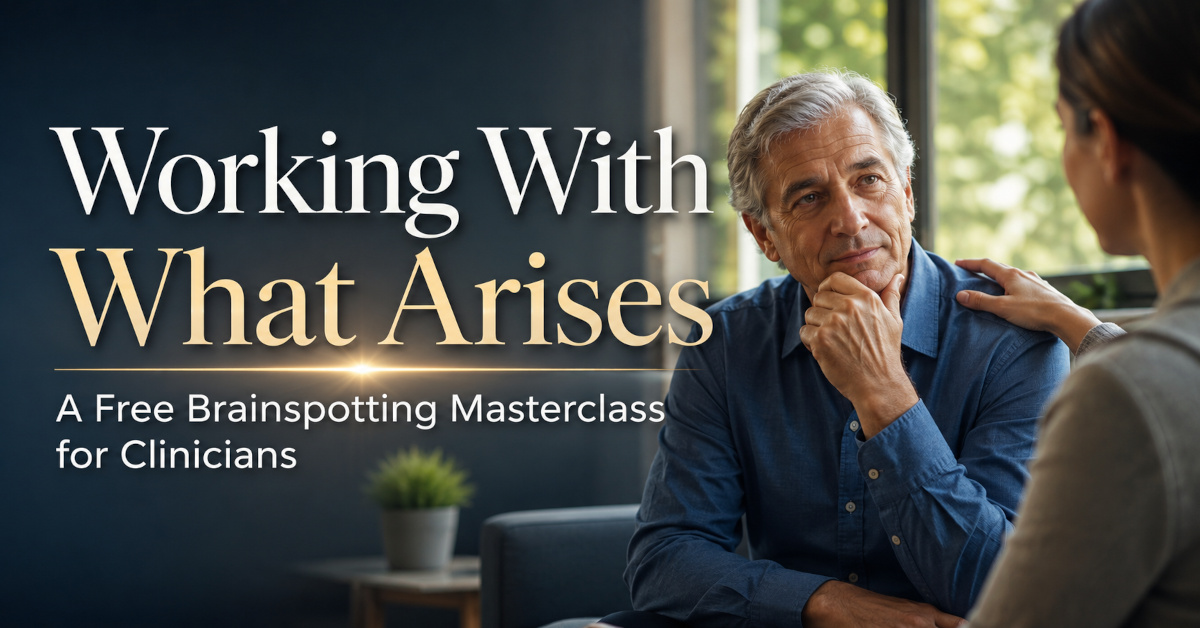
Working with What Arises: A Brainspotting Masterclass for Clinicians with David Grand and Diane Poole Heller
There are moments in trauma work when you can sense something vital is happening, yet it has not fully entered words. A client’s gaze shifts, the body tightens, or language starts to thin out, and you know there is more present than the story alone can explain.
This live training explores how Brainspotting meets those moments directly. Rather than moving too quickly into interpretation, the approach helps you stay with what is already arising in the nervous system so deeper processing can unfold with clarity and care.
In this experiential masterclass with Dr. David Grand and Dr. Diane Poole Heller, you’ll be introduced to a grounded framework for working with trauma beneath the level of narrative. You’ll see how eye position, attunement, and focused presence can help clinicians access unresolved material in real time.
If you want a more precise way to recognize and support healing as it is happening, this session offers a practical and thoughtful place to deepen your understanding.
Why Attend “Working with What Arises”
When trauma lives beneath what is spoken, clinicians need ways to stay with the process without forcing it into explanation too soon. This training shows how Brainspotting helps you recognize where activation and processing are already happening, which means you can work with greater precision while remaining deeply attuned.
Dr. David Grand and Dr. Diane Poole Heller bring together decades of experience in trauma resolution, attachment, and embodied healing, so the teaching stays clinically relevant and grounded. You will not only hear the principles behind the model, but also see how subtle shifts in gaze, presence, and body cues can guide the work in real time.
Watching the method demonstrated live can change how you understand therapeutic process itself. Instead of trying to direct every next step, you begin to recognize what the client’s system is already revealing, so that healing can emerge with more trust, confidence, and respect for what naturally unfolds.
What You’ll Learn During This Brainspotting Masterclass
In this session, you’ll begin with the foundations of Brainspotting, so you can understand how eye position, focused mindfulness, and relational attunement open access to trauma held below conscious narrative. You’ll also see why this matters clinically, which means you can better recognize when deeper material is already close to the surface.
We’ll look at the somatic and neurological cues that signal activation, regulation, and processing in real time, and then connect those cues to practical therapeutic presence. You’ll learn how to stay with what is emerging without interrupting it, so your work can become both more precise and less directive.
You’ll also witness a live demonstration of the method, which means the teaching moves beyond theory into lived clinical observation. By the end, you’ll have a clearer sense of how to track what arises in the body and nervous system so that meaningful change can unfold from within the client’s own process.
Here’s just a little bit of what you’ll learn:
- How Brainspotting accesses trauma held beneath conscious awareness
- Why eye position can reveal entry points into unresolved material
- The role of attunement in supporting deep processing and safety
- What subtle gaze and body shifts may signal in session
- How to recognize activation, regulation, and resolution in real time
- Ways to follow the client’s process without forcing interpretation
- How Brainspotting works beneath the level of narrative and cognition
- What makes the approach structured while remaining non-prescriptive
- How a live Brainspotting demonstration can sharpen clinical perception
- Where this model can complement trauma, attachment, somatic, and parts work
Who This Brainspotting Training Is For
This masterclass is especially well suited for trauma clinicians, therapists, and mental health professionals who want a deeper understanding of how to work with what is happening beneath the spoken story. If you already sense those important moments in session but want a clearer way to track and support them, this training offers a strong clinical foundation.
It is also a fit for somatic practitioners, attachment-focused professionals, coaches, and others who work with human change in an embodied way. Whether you are already familiar with trauma resolution models or are primarily trained in cognitive approaches, this session can help you see how healing processes unfold in real time and how to stay present to them.
- Trauma clinicians and licensed mental health professionals
- Therapists working with attachment wounds and developmental trauma
- Somatic practitioners and body-based healing professionals
- Coaches and consultants supporting stuck patterns and reactivity
- Clinicians curious about subcortical trauma processing
- Practitioners wanting more confidence with subtle clinical cues
- Professionals trained mainly in cognitive or insight-based models
- Helpers looking for a grounded introduction to Brainspotting
About Dr. David Grand and Dr. Diane Poole Heller
David Grand, PhD, is the developer of Brainspotting, a relational brain-body and mindfulness-based method that has reshaped trauma therapy for clinicians around the world. He is also a Licensed Clinical Social Worker, author of Brainspotting: The Revolutionary New Therapy for Rapid and Effective Change, and co-author of This is Your Brain on Sports.
Dr. Grand has supported survivors of major collective tragedies, including 9/11, Hurricane Katrina, and Sandy Hook/Newtown, and his work also extends into performance and creativity. Through international trainings, lectures, and consultation, he has equipped tens of thousands of therapists and helping professionals with practical ways to work with trauma and human potential.
Diane Poole Heller, PhD, is an internationally recognized speaker, author, and teaching expert in the field of adult attachment theory and trauma resolution. Her signature approach, DARe: Dynamic Attachment Re-patterning experience, gives therapists and individuals practical tools for healing attachment and trauma wounds in ways that are grounded, relational, and effective.
Dr. Heller is the author of several books, including The Power of Attachment: How to Create Deep and Lasting Intimate Relationships. Her work has supported survivors, helpers, and families affected by 9/11, Columbine, and other school shootings, and she has helped countless people build greater intimacy, resilience, and security in their lives and relationships.
Reviews
“Brainspotting has transformed the way I work with most of my clients.
It has changed my views about talking therapies and accessing inner processes without the need for a lot of dialogue.”
––Sarah
“Before I began learning about Brainspotting, I felt entrenched in the medical model. I was trying to free myself from the constraints of linear thinking about therapy.
Now I have a framework to deeply attune, to be with uncertainty and constant evidence of the healing process of Brainspotting.
I was not expecting the fulfillment from this radical change nor was I expecting my own healing.”
––Clare
“Brainspotting has enabled me to help so many clients with differing issues.
It truly is a fantastic tool to have in your toolbox. Brainspotting enables me to really start the healing process, freeing clients of trapped emotions and helping them start to process their traumas.
It is an integral part of the therapy I undertake and I absolutely love this modality!”
––Victoria
“I learned to trust the healing power of the human brain…
… and it helped me develop a new layer of presence that is so essential in trauma work.”
––Philip
Frequently Asked Questions
FAQ Quick Links:
- When and where does the event take place?
- Who are the teachers?
- What will I learn during this event?
- What if I can’t attend live?
- How long is the event?
- Do I need any special equipment to participate?
- Who is hosting the event?
- Is this event suitable for beginners?
- Is this event religious?
- Will there be an opportunity to go deeper after the event?
- What can I expect to feel during the event?
- Can I share this event with friends or colleagues?
- Is this event really free?
- What is Brainspotting?
- How does eye position relate to trauma processing?
- Will there be a live demonstration during the training?
- Is this masterclass only for licensed therapists?
- Can Brainspotting complement other trauma modalities?
- Will the session address attachment and relational attunement?
- What makes Brainspotting different from talk-based approaches?
- How should I prepare for the live session?
- Register Here For Free
When and where does the event take place?
This live online training takes place on Thursday, May 21, 2026 at 10 am Pacific Time (PT). Once you register, you’ll receive the details you need to join from anywhere.
Who are the teachers?
Your teachers are Dr. David Grand, the creator of Brainspotting, and Dr. Diane Poole Heller, an internationally recognized expert in attachment and trauma resolution.
What will I learn during this event?
You’ll learn the core principles behind Brainspotting, how eye position can help access unresolved trauma, what somatic and neurological cues to watch for in session, and how attunement supports deep processing in real time.
What if I can’t attend live?
Register anyway. A free limited-time replay will be made available to those who sign up.
How long is the event?
This masterclass is approximately 90 minutes long.
Do I need any special equipment to participate?
You only need a reliable internet connection and a device that can stream the session. Headphones and a quiet space may help you focus more fully.
Who is hosting the event?
This event is hosted by Diane Poole Heller and Trauma Healing Solutions.
Is this event suitable for beginners?
Yes. The training is accessible for people who are new to Brainspotting, while still offering valuable insight for experienced clinicians and trauma professionals.
Is this event religious?
No. This masterclass is educational and clinically focused, and it welcomes people from all backgrounds and belief systems.
Will there be an opportunity to go deeper after the event?
Yes. During the training, you may hear about ways to continue learning if you want to explore the approach in greater depth after the event.
What can I expect to feel during the event?
You can expect a grounded mix of teaching, observation, and clinical reflection. Many people find this kind of session both clarifying and energizing because it helps them understand trauma work in a more embodied way.
Can I share this event with friends or colleagues?
Yes. Feel free to share it with colleagues, peers, and other professionals who may benefit from learning more about Brainspotting and trauma resolution.
Is this event really free?
Yes. Registration for this live masterclass is free.
What is Brainspotting?
Brainspotting is a trauma treatment approach developed by Dr. David Grand that uses eye position, mindful attention, and attuned presence to help access and process unresolved material held deep in the brain and body.
How does eye position relate to trauma processing?
In Brainspotting, eye position can reveal where activation is linked to unresolved experiences. When clinicians track and hold attention on those points carefully, the client’s system may begin to process material that is difficult to reach through words alone.
Will there be a live demonstration during the training?
Yes. One of the highlights of the event is a live demonstration with Dr. Grand so you can observe how the model unfolds in actual practice.
Is this masterclass only for licensed therapists?
No. It is especially relevant for clinicians, though coaches, somatic practitioners, and other helping professionals interested in trauma healing may also find it valuable.
Can Brainspotting complement other trauma modalities?
Yes. Brainspotting can sit alongside other approaches such as attachment work, somatic practices, and parts-oriented models, which means many professionals use it to deepen the work they already do.
Will the session address attachment and relational attunement?
Yes. Because Dr. Diane Poole Heller is part of the training, the session includes a strong relational lens and helps illuminate how attunement supports trauma healing.
What makes Brainspotting different from talk-based approaches?
Rather than relying primarily on narrative insight, Brainspotting works directly with subcortical and somatic processes. This allows clinicians to stay with what is happening beneath the story so deeper material has room to emerge and resolve.
How should I prepare for the live session?
Set aside uninterrupted time, arrive a few minutes early, and have something nearby for notes. Coming in with curiosity and clinical openness will help you get the most from the experience.
Health Disclosure: The contents of this website/e-mail are for informational purposes only and are not intended to be a substitute for professional medical advice, diagnosis, or treatment. This website does not provide medical advice, diagnosis, or treatment. Always seek the advice of your physician or other qualified health provider with any questions you may have regarding a medical condition.
Relationship Disclosure: We are grateful to be of service and bring you these life-changing events free of charge. In order to do this, please note that whenever you click the links and purchase items, in most (not all) cases we will receive a referral commission. We may receive a listing fee for publishing this event.
Your support in purchasing through these links makes it possible for people in over 150 countries globally to attend these life-changing events for free. Thank you! :)
- May 21 2026
- Expired!
- 10:00 am - 11:30 am
Local Time
- Timezone: America/New_York
- Date: May 21 2026
- Time: 1:00 pm - 2:30 pm
More Info
- Worldwide