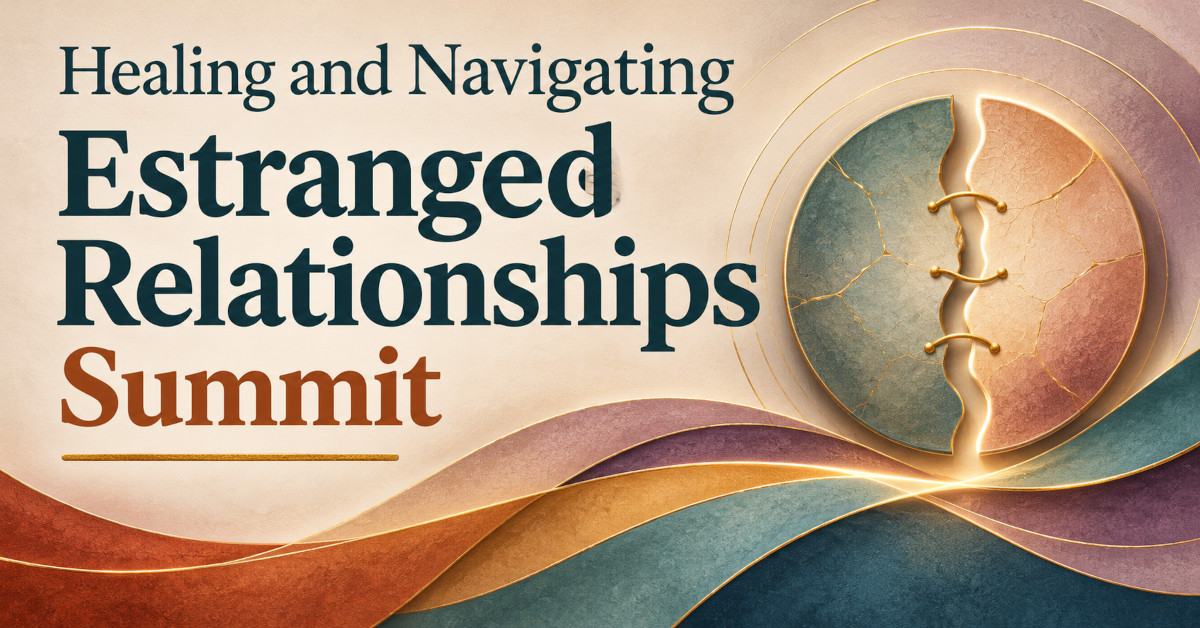
Healing and Navigating Estranged Relationships Summit – Free Event Hosted by Avaiya
Estrangement can leave you carrying grief, guilt, anger, unanswered questions, and the exhausting pressure to decide whether to reconnect, step back, or protect the distance you have already created.
Healing & Navigating Estranged Relationships brings together 20 relationship, trauma, somatic, and personal-growth teachers for practical guidance on family ruptures, boundaries, no contact, codependency, attachment wounds, nervous system regulation, high-conflict dynamics, and rebuilding trust in yourself.
The three-day online series is designed for people on either side of estrangement. Whether you chose distance, had distance chosen for you, or are still trying to decide what kind of contact feels healthy, the sessions offer different ways to understand what happened and respond with greater clarity.
You can focus on the teachers and topics that speak most directly to your situation, from Inner Bonding and family constellations to sacred boundaries, scapegoating, relational repair, and the stages of healing after a rupture.
Why Attend Healing & Navigating Estranged Relationships
Estrangement rarely creates only one emotion. You may miss someone and still need distance, hope for repair while fearing another painful cycle, or know that a boundary is necessary while continuing to wrestle with guilt and self-doubt. The summit creates room to explore those tensions without assuming that every relationship has the same answer.
The 20 featured teachers approach relationship rupture from different angles, including boundaries, attachment, Inner Bonding, codependency, scapegoating, family systems, high-conflict behavior, relational repair, nervous system regulation, and grief. This range gives you several ways to understand what may be happening beneath the conflict and consider which ideas fit your circumstances.
The focus is on practical education that can help you respond more intentionally to difficult relational dynamics. Rather than making reconciliation or permanent separation the only measure of progress, the sessions explore self-trust, emotional regulation, healthier contact decisions, and ways to care for yourself when another person will not participate in change.
Who Should Attend Healing & Navigating Estranged Relationships
This summit is for adults navigating distance, rupture, or persistent conflict in an important relationship. That may include estrangement from a parent, adult child, sibling, partner, former partner, friend, or another person whose absence or behavior continues to affect your emotional life.
It can also be useful when the relationship is not completely severed but contact leaves you anxious, guilty, confused, or emotionally depleted. You can attend whether you hope for reconciliation, are considering lower contact, have chosen no contact, or are trying to make peace with someone else’s decision to step away.
- People grieving the loss or distancing of a parent, child, sibling, partner, or close friend
- Anyone struggling with guilt or self-doubt after setting stronger boundaries
- People deciding between full contact, low contact, or no contact
- Adults dealing with codependency, over-functioning, or the urge to rescue others
- People who have been labeled the family scapegoat or black sheep
- Anyone trying to understand attachment wounds or confusing relationship cutoffs
- People navigating manipulative, controlling, or high-conflict relationship dynamics
- Those who want to rebuild self-trust even when another person will not participate in repair
What You’ll Learn During Healing & Navigating Estranged Relationships
The sessions examine estrangement as more than a question of whether two people are speaking. You’ll explore the emotional patterns, family roles, attachment wounds, nervous system responses, expectations, and boundaries that can shape what happens before and after a relationship rupture.
You will also hear different approaches to contact and repair. Some sessions focus on reconciliation and relational healing, while others address situations where distance, low contact, or no contact may be part of protecting your wellbeing.
Throughout the series, the emphasis stays on what you can understand and influence in your own life. That includes learning to recognize unhelpful coping loops, regulate difficult reactions, clarify boundaries, and build a steadier relationship with yourself.
- How healing work can begin even when the other person refuses to participate
- Ways to choose and navigate a level of family contact that protects your wellbeing
- How to set boundaries without making guilt the final authority on your decisions
- What can keep people stuck after estrangement and what may support forward movement
- How attachment wounds and unspoken grief can contribute to emotional distance
- Ways codependency and the scapegoat role can complicate adult family relationships
- Brain-based and somatic perspectives on relational stress and emotional triggers
- How to respond more intentionally to high-conflict or controlling dynamics
- How family-system and ancestral patterns may influence present-day relationship conflict
- Ways to reconnect with your values, self-trust, and sense of identity after a rupture
Healing When the Other Person Does Not Participate
One recurring theme in the summit is that your next step does not have to depend entirely on another person’s willingness to apologize, change, explain themselves, or participate in reconciliation. Ann Weiser Cornell’s session directly explores the idea that one person can begin changing the way a relationship is held and experienced.
Other sessions build on that broader principle from different directions. Dr. Margaret Paul explores Inner Bonding, Jerry Wise addresses choosing a level of family contact that protects the self, and Bernadette Logue focuses on reconnecting with your True Self through the experience of estrangement.
This approach does not guarantee that another person will return or that every relationship can safely be repaired. It shifts attention toward the part of the process you can influence: your boundaries, patterns, emotional responses, self-understanding, and decisions about what kind of relationship is workable for you.
- Separate your healing from another person’s willingness to change
- Notice where guilt, fear, or hope may be driving contact decisions
- Clarify what healthy participation in a relationship would require from you
- Build a stronger internal foundation whether the relationship changes or not
Featured Speakers and Topics
The summit brings together 20 teachers whose sessions examine estrangement from psychological, relational, somatic, family-systems, and personal-growth perspectives. Use the topics below to identify the presentations that connect most closely with the questions you are carrying.
Dr. Margaret Paul – The Inner Bonding Path to Relationship Reconciliation
Explore Inner Bonding as a way to understand your relationship with yourself and how that inner relationship can influence connection, conflict, and the possibility of reconciliation.
Jerry Wise – Choosing and Navigating a Level of Family Contact That Protects Your Self
Consider how to make more grounded decisions about full contact, lower contact, or greater distance while paying attention to the effect those choices have on your wellbeing.
Dr. Sharon Martin – Healing From Family Estrangement: What Helps and What Keeps You Stuck
Examine common patterns that can prolong distress after family estrangement and practical directions that may support a healthier recovery process.
Mark Waldman – Brain-Based Strategies to Rebuild Broken Relationships
Explore brain-based approaches to communication, emotional response, and relational repair when conflict has damaged trust or connection.
Ann Weiser Cornell – It Only Takes One Person to Begin to Heal a Relationship
Learn why meaningful inner and relational work can begin without waiting for another person to apologize, agree with you, or take the first step.
Michelle Farris – Codependency and Adult Child Estrangement: How to Heal
Look at how codependent patterns, over-functioning, rescuing, and blurred boundaries can affect estrangement between parents and adult children.
Kyle Benson – The Hurt Beneath the Distance: Attachment, Boundaries, and the Path to Repair
Explore the attachment wounds and emotional pain that can sit underneath distance, along with the role boundaries may play in creating healthier relationship conditions.
Laura K. Connell – Going No Contact with a Narcissistic Mother
Consider the emotional and boundary challenges involved in going no contact with a highly difficult or narcissistic mother.
Jay Reid – Heal Thy Self First: How Scapegoat Survivors Can Navigate Estranged Familial Relationships
Explore family scapegoating, the impact of being assigned the outsider role, and ways to center your own recovery while navigating estranged family relationships.
Dr. Ameet Aggarwal – Family Constellations: Healing Family Trauma and Estrangement
Learn about a family-constellations perspective on systemic patterns, inherited burdens, exclusions, and unresolved family dynamics that may echo through present relationships.
Bernadette Logue – Estranged Relationships Invite You to Reconnect to Your True Self
Explore how the experience of estrangement can become an invitation to strengthen your identity, values, self-connection, and inner direction.
Tracy Malone – When Estrangement Doesn’t Make Sense
Consider ways to create clarity when a cutoff feels sudden, confusing, contradictory, or difficult to understand from the information available to you.
Misa Hopkins – 3 Secrets for Creating Sacred Boundaries
Explore a boundary-centered approach to protecting your emotional space while making intentional choices about how you participate in difficult relationships.
Rachel Grant – Choosing Yourself Without Guilt: Navigating the Heartbreak of Estranged Family Relationships
Learn ways to examine guilt, self-blame, and the fear of being the “bad guy” when protecting yourself requires stronger limits or greater distance.
Marina Triner – The Stages of Healing from Estrangement and Its Gifts
Explore different phases that can arise after estrangement, from shock and survival responses toward greater integration, self-trust, and renewed engagement with life.
Cheryl Fidelman – The Estrangement Within: The Relationship Beneath Every Relationship
Turn attention inward to the relationship with yourself and consider how internal patterns can shape the way you experience disconnection, longing, and relational pain.
Annie Kaszina – How to Heal the Pain of Estrangement
Explore practical emotional perspectives for working with the grief and pain that can remain after an important relationship becomes distant or severed.
Dr. Allen Berger – Room Enough for Two
Consider what it takes for two people to exist in a relationship without one person’s needs, identity, or perspective consuming the other’s.
Lise Leblanc – De-escalating High-Conflict Narcissists: Protecting Your Peace
Explore strategies for recognizing escalation, reducing engagement with destabilizing dynamics, and protecting your emotional energy in high-conflict interactions.
Jodi Cohen – Essential Oils for Nervous System Regulation
Hear an educational perspective on essential oils in the context of nervous system regulation and relational stress. Health-related information in this session is educational and is not a substitute for individualized medical care.
Dates, Access, Replays and Where to Watch
Healing & Navigating Estranged Relationships is a three-day online series running Tuesday through Thursday.
After registering, check your email for the viewing links, access instructions, and updates for the free classes. Replays are available for 24 hours after each class airs.
Because access is delivered by email, a few simple inbox habits can make the three days easier to navigate:
- Register with an email address you check regularly
- Watch for the AVAIYA confirmation and access messages after registration
- Check Promotions or Spam if an expected message does not appear
- Star or flag the summit email thread so the viewing links are easier to find
- Use the featured speaker list to choose the sessions most relevant to you
How to Register for Healing & Navigating Estranged Relationships
Click any Register Here For Free button on this page, enter your contact information, and check your email for access details.
How to Get the Most From the Summit
A summit about estrangement can bring up a lot at once. You may recognize yourself in several sessions, hear ideas that challenge your assumptions, or find that one topic feels especially emotionally charged.
You do not need to resolve your entire relationship history during the three days. A focused approach can help you learn without turning the summit into another source of pressure.
1. Start With Your Most Important Question
Choose one question you most want help thinking through, such as boundaries, guilt, contact decisions, reconciliation, codependency, scapegoating, or nervous system regulation.
2. Choose Sessions by Relevance
Use the featured speaker topics to identify the presentations that most closely match your current circumstances rather than trying to absorb every perspective equally.
3. Separate Insight From Immediate Action
- Write down ideas that feel useful before making major relationship decisions
- Notice which insights bring greater clarity rather than greater urgency
- Give emotionally charged material time to settle before acting on it
4. Keep One Practical Takeaway
After a session, identify one boundary, reflection question, communication practice, or self-care step that feels realistic enough to explore further.
5. Use Professional Support When Appropriate
Estrangement can involve trauma, abuse, mental health concerns, legal issues, or complicated family systems. Educational summit sessions can offer perspective, but individualized support from an appropriate qualified professional may be important for decisions specific to your circumstances.
About iKE ALLEN and Ande Anderson
iKE ALLEN and Ande Anderson, MS, RD, are the founders and co-owners of AVAIYA University, the organization bringing together the teachers featured in Healing & Navigating Estranged Relationships.
AVAIYA creates films, courses, and global online conferences focused on personal challenges, emotional wellbeing, relationships, health, and personal growth. Its events bring multiple teachers together around a central theme so participants can hear different perspectives rather than relying on a single approach.
Past AVAIYA programming has explored subjects including childhood trauma, betrayal and abandonment wounds, depression and loneliness, codependency, insecurity and self-esteem, somatic resilience, difficult family dynamics, and relationship challenges.
For this three-day series, iKE ALLEN and Ande Anderson bring together 20 teachers to examine estrangement from relational, psychological, somatic, family-systems, and personal-growth perspectives.
Frequently Asked Questions
Select any question below to reveal the answer.
When and where does Healing & Navigating Estranged Relationships take place?
Is the summit free to attend?
How long does the summit run?
Are replays available?
How do I access the summit sessions?
Do I need to watch every session?
Who is this summit for?
Can I attend if the other person was the one who ended contact?
Is the summit only for people who want reconciliation?
Who will be speaking?
What topics are covered?
Can healing begin if the other person refuses to participate?
Will the summit help me think about low contact or no contact?
Are boundaries covered?
Does the summit address codependency and family scapegoating?
Does the summit include nervous system or somatic perspectives?
Are family patterns and ancestral dynamics explored?
What is the Inner Bonding topic in the summit?
Does the summit address high-conflict or narcissistic relationship dynamics?
Who is hosting Healing & Navigating Estranged Relationships?
Is the summit a substitute for therapy or medical care?
How do I register for the summit?
The contents of this website/e-mail are for informational purposes only and are not intended to be a substitute for professional medical advice, diagnosis, or treatment. This website does not provide medical advice, diagnosis, or treatment. Always seek the advice of your physician or other qualified health provider with any questions you may have regarding a medical condition.
We are grateful to be of service and bring you these life-changing events free of charge. In order to do this, please note that whenever you click the links and purchase items, in most (not all) cases we will receive a referral commission. We may receive a listing fee for publishing this event.
Your support in purchasing through these links makes it possible for people in over 150 countries globally to attend these life-changing events for free. Thank you!
Register for Healing & Navigating Estranged Relationships to receive access details for the three-day online series and explore practical perspectives from 20 featured teachers.
- Nov 17 - 19 2026
- 8:00 am - 6:00 pm
Local Time
- Timezone: America/New_York
- Date: Nov 17 - 19 2026
- Time: 11:00 am - 9:00 pm
More Info
- Worldwide