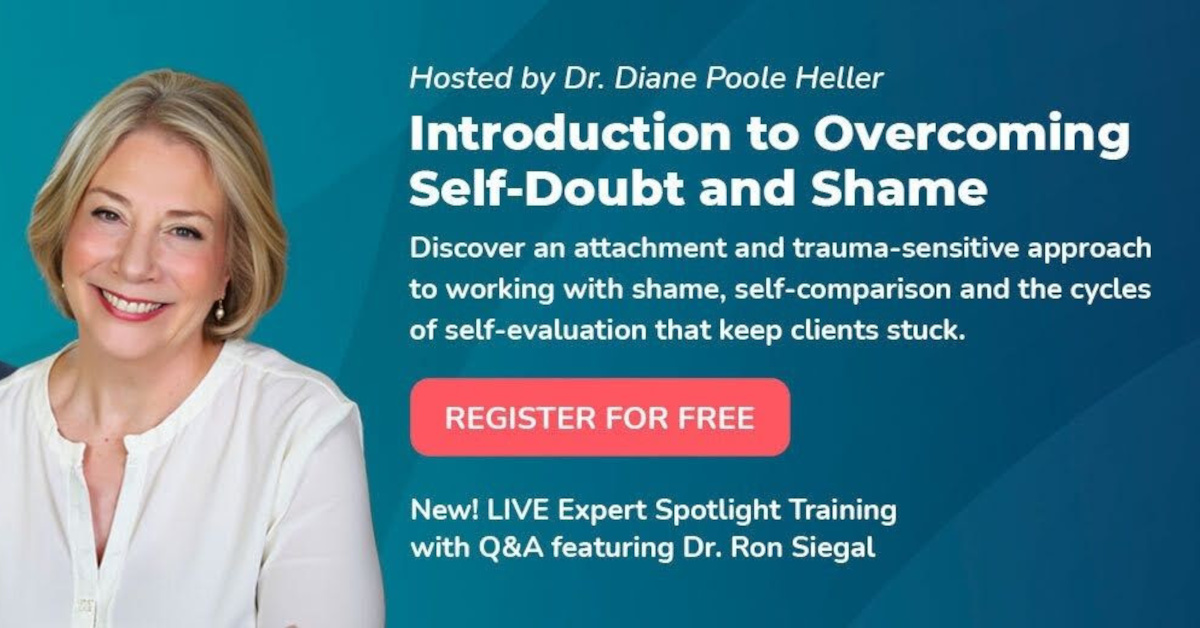
Overcoming Self-Doubt and Shame – Free Webinar with Diane Poole Heller and Ron Siegal
Shame and self-doubt can be some of the most persistent forms of suffering we meet in clinical work. They shape how clients interpret feedback, relationships, and even small moments of uncertainty, and then those interpretations can harden into a constant inner evaluation.
When someone is caught in comparison and not-enoughness, insight often helps them name what is happening, and then the cycle still returns. The mind keeps measuring worth, and the nervous system stays braced for rejection, failure, or falling short.
This training offers a trauma- and attachment-sensitive way to understand what is underneath self-criticism, collapse, perfectionism, and overcompensation. Rather than trying to inflate self-esteem, you’ll explore how to help clients step out of automatic self-evaluation and into steadier compassion and psychological flexibility.
You’ll leave with a clearer map of how shame operates and practical, body-aware ways to work with it in session, including approaches you can apply to your own inner critic when it shows up in the room.
Why Attend “Introduction to Overcoming Self-Doubt and Shame”
Many clients don’t just feel bad about themselves; they feel watched by an inner judge that is always keeping score. That inner evaluation can turn a passing mistake into shame, which means a nervous system response gets treated like a personal flaw.
In this masterclass, you’ll explore why self-doubt and inflated self-esteem can come from the same protective system, and then how that system fuels cycles of striving, comparison, collapse, and overcompensation. Seeing the cycle clearly helps you intervene with more precision, so you’re not accidentally reinforcing the very pattern you’re trying to heal.
You’ll also gain practical ways to work with shame in the room that honor attachment and trauma realities, so clients can relate differently to self-critical thoughts and the sensations that come with them. Over time, this supports a steadier sense of worth that is less dependent on performance, approval, or feeling “special.”
What You’ll Learn During “Introduction to Overcoming Self-Doubt and Shame”
Let’s start with what is most useful in practice: a clear way to understand self-evaluative suffering, so you can track it in real time and respond skillfully. You’ll explore how shame and self-doubt organize experience, which means you can help clients notice the pattern without being swallowed by it.
In this session, you’ll learn why insight alone often isn’t enough, and then how attachment history, trauma, and neurobiology keep the self-esteem roller coaster running. You’ll leave with ways to work with the body and attention, so clients can loosen the grip of the judging mind and build more stable inner safety.
We’ll stay grounded and clinically relevant, and then translate the framework into concrete in-session moves you can use right away. You’ll also have space to reflect on how therapist self-doubt shows up, so your own internal pressure can soften and the relationship can feel more secure.
Here’s just a little bit of what you’ll learn:
- How shame and self-doubt are shaped by evolution, attachment, and trauma
- Why social rank sensitivity can amplify comparison and not-enoughness
- How self-criticism and grandiosity can come from one protective system
- The boost-and-collapse cycle that keeps clients stuck in self-evaluation
- Why trying to simply boost self-esteem can reinforce the same suffering
- How to work with shame as a nervous system pattern, not a character flaw
- Mindfulness-based ways to notice the judging mind without obeying it
- Body-aware tools for meeting collapse, activation, and shame in session
- Ways to support connection, common humanity, and values-based living
Who This Is For
This masterclass is designed for clinicians who want a more grounded, compassionate way to work with shame, perfectionism, chronic self-criticism, and the feeling of never being enough. If you support clients who understand their patterns and still get pulled back into them, this framework will help you work closer to the roots.
It’s also supportive if you notice your own performance pressure or self-doubt entering the room. When you can recognize self-evaluation as a protective system, you can respond with more steadiness, so the work feels less like fixing and more like helping clients return to connection and flexibility.
- Therapists, counselors, psychologists, and social workers working with shame and self-evaluation
- Clinicians supporting perfectionism, self-criticism, and chronic not-enoughness
- Practitioners seeing cycles of collapse and overcompensation in clients
- Trauma- and attachment-informed clinicians who want a compatible map
- Somatic, psychodynamic, relational, and mindfulness-informed practitioners
About Dr. Ronald D. Siegel and Dr. Diane Poole Heller
Dr. Ronald D. Siegel, PsyD, is Assistant Professor of Psychology at Harvard Medical School, where he has taught since the early 1980s. He teaches internationally on the application of mindfulness in psychotherapy and other fields, and he maintains a private clinical practice in Lincoln, Massachusetts.
Known for warmth, clarity, and depth, Dr. Siegel helps clinicians understand complex emotional suffering in ways that are both humane and immediately useful. His work bridges contemplative psychology, attachment perspectives, and clinical experience, with a steady emphasis on practical application.
He is the author of The Extraordinary Gift of Being Ordinary and The Mindfulness Solution, and coeditor of the acclaimed text Mindfulness and Psychotherapy. Across his teaching, he offers clinicians a path to work with self-judgment and shame without forcing change through willpower or self-improvement.
This session is hosted by Dr. Diane Poole Heller, an internationally recognized speaker and author in the field of adult attachment theory and trauma resolution. Her teaching supports clinicians in bringing greater safety, connection, and secure attachment skills into therapeutic work.
Frequently Asked Questions
FAQ Quick Links:
- When and where does the event take place?
- Who is this masterclass for?
- What will I learn during this event?
- What if I can’t attend live?
- How long is the event?
- Do I need any special equipment to participate?
- Who is hosting the event?
- Is this event suitable for beginners?
- Is this event religious?
- Will there be an opportunity to go deeper after the event?
- What can I expect to feel during the event?
- Can I share this event with friends or colleagues?
- Is this event really free?
- What does it mean to step off the self-esteem roller coaster?
- How can self-doubt and inflated self-esteem come from the same place?
- What makes this approach trauma- and attachment-sensitive?
- Will there be practices or a live demo?
- Is this training only for clinicians?
- Will this offer CE credits?
- Can this help me with my own self-doubt as a therapist?
- How do I register and get access details?
- Register Here For Free
When and where does the event take place?
This free online masterclass takes place on Wednesday, April 15, 2026, at 10:00am Pacific Time (PT). After you register, you will receive an email with access details to join live.
Who is this masterclass for?
This training is especially useful for therapists, counselors, psychologists, and other helping professionals working with shame, perfectionism, self-criticism, and chronic not-enoughness. It is also relevant for clinicians who notice therapist self-doubt or performance pressure showing up in the clinical relationship.
What will I learn during this event?
You will learn an attachment- and trauma-sensitive framework for understanding shame and self-doubt, how self-criticism and overcompensation can arise from the same protective system, and practical mindfulness- and body-aware ways to work with self-evaluative patterns in session.
What if I can’t attend live?
No problem. If you register, replay details will be sent after the event so you can watch at your convenience.
How long is the event?
Approximately 90 minutes.
Do I need any special equipment to participate?
No special equipment is required. A reliable internet connection and a device with speakers or headphones is helpful, and a quiet space supports focus.
Who is hosting the event?
This event is presented by Trauma Healing Solutions.
Is this event suitable for beginners?
Yes. The teaching is accessible and clear, and it is designed to be useful across modalities, including for clinicians newer to mindfulness- and body-aware approaches.
Is this event religious?
No. The training is non-religious and welcomes participants of all backgrounds and beliefs.
Will there be an opportunity to go deeper after the event?
Yes. You may hear about additional learning opportunities after the masterclass if you would like to continue exploring the material.
What can I expect to feel during the event?
Many people feel more clarity and steadiness after naming the self-evaluation cycle with compassion. You may also notice tenderness or recognition as the material connects to your own clinical experience and inner critic.
Can I share this event with friends or colleagues?
Yes. Feel free to share the registration link with colleagues or friends who would benefit from a clinically grounded approach to shame and self-doubt.
Is this event really free?
Yes. There is no cost to attend the live masterclass. If you choose to continue into a paid program afterward, details will be shared separately.
What does it mean to step off the self-esteem roller coaster?
It means shifting away from trying to feel worthy by getting a boost from success, approval, or comparison, and then crashing when life does not cooperate. Instead, the focus is on stepping out of constant self-evaluation and building steadier well-being rooted in awareness, connection, and compassion.
How can self-doubt and inflated self-esteem come from the same place?
Both can be attempts to manage vulnerability and protect against shame. When the mind is organized around measuring worth, it may swing between harsh self-criticism and overcompensation as different strategies to avoid feeling not-enough.
What makes this approach trauma- and attachment-sensitive?
It recognizes that shame and self-doubt are shaped by early attachment experiences, nervous system protection, and sensitivity to rejection and belonging, not just distorted thoughts. This supports interventions that include the body, relationship, and pacing, rather than relying only on cognitive reframing.
Will there be practices or a live demo?
Yes. The masterclass includes teaching and experiential elements, and there is also time for Q&A.
Is this training only for clinicians?
The training is oriented toward clinicians and clinical work, though anyone interested in a grounded approach to shame and self-doubt may find it helpful. The examples and framing are designed to translate directly into therapeutic practice.
Will this offer CE credits?
Information about continuing education credit, if available, will be provided on the registration page or in event emails. If CE is important for you, please check the event details after you register.
Can this help me with my own self-doubt as a therapist?
Yes. Many clinicians recognize versions of the same self-evaluative patterns in themselves, especially under pressure. The framework and practices can support you in meeting your own inner critic with more clarity and compassion, which often strengthens presence with clients.
How do I register and get access details?
Register using the button on this page. After you register, you will receive email instructions with the access link and any important reminders.
Health Disclosure: The contents of this website/e-mail are for informational purposes only and are not intended to be a substitute for professional medical advice, diagnosis, or treatment. This website does not provide medical advice, diagnosis, or treatment. Always seek the advice of your physician or other qualified health provider with any questions you may have regarding a medical condition.
Relationship Disclosure: We are grateful to be of service and bring you these life-changing events free of charge. In order to do this, please note that whenever you click the links and purchase items, in most (not all) cases we will receive a referral commission. We may receive a listing fee for publishing this event.
Your support in purchasing through these links makes it possible for people in over 150 countries globally to attend these life-changing events for free. Thank you! :)
- Apr 15 2026
- Expired!
- 10:00 am - 11:30 am
Local Time
- Timezone: America/New_York
- Date: Apr 15 2026
- Time: 1:00 pm - 2:30 pm
More Info
- Worldwide