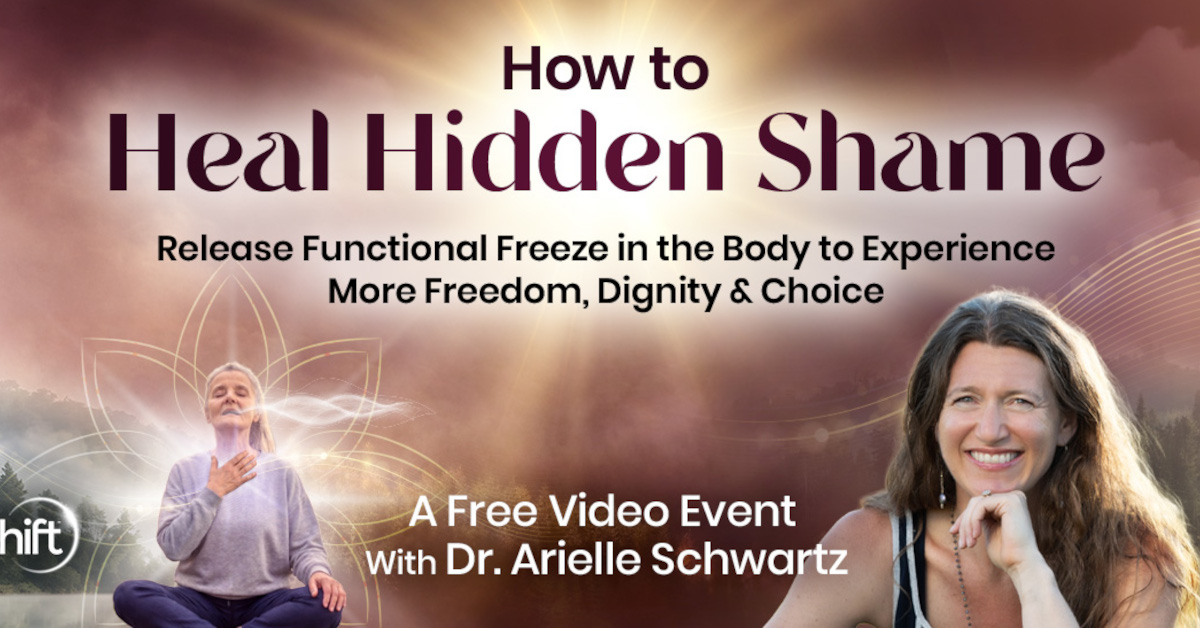
How to Heal Hidden Shame – Free Class with Arielle Schwartz
Shame does not always feel like embarrassment. It can appear as a quiet contraction, a disappearing voice, a persistent sense of “not enough,” or the feeling that some part of you still needs to hide.
Dr. Arielle Schwartz offers a compassionate framework for understanding these reactions as protective responses rather than character flaws. Her approach brings together trauma therapy, nervous system science, somatic psychology, parts work, therapeutic yoga, and mindfulness.
You’ll explore how shame can become tangled with anger, grief, and anxiety, and how emotional intelligence can help you relate to these feelings with greater clarity. Arielle will also guide a somatic practice using breath, movement, sound, and embodied awareness.
This event is an invitation to notice how hidden shame may shape self-expression, relationships, and your sense of worth. The focus is not on forcing change, but on meeting protective patterns with curiosity, dignity, and practical awareness.
Why Attend “How to Heal Hidden Shame: Release Functional Freeze in the Body to Experience More Freedom, Dignity & Choice”
Hidden shame can shape your life without announcing itself clearly. It may show up when your body contracts, your voice disappears, or an old belief that you are inadequate rises before conscious thought can intervene.
Arielle reframes shame as a protective response that may have developed when belonging, connection, safety, or self-expression felt threatened. This perspective matters because it shifts the question away from what is wrong with you and toward how your body and nervous system learned to adapt.
Her approach is useful because it connects emotional understanding with direct somatic awareness. By bringing together trauma recovery, nervous system science, parts work, therapeutic yoga, and mindfulness, she offers a grounded way to explore difficult emotions without reducing shame to your identity.
What You’ll Learn
We’ll begin by looking at shame as a learned protective response, so you can consider how it may have formed around threatened belonging, connection, safety, or self-expression. You’ll explore why recognizing its protective purpose can create a more compassionate way to relate to yourself.
In this session, you’ll examine the building blocks of emotional intelligence, which means learning not only to identify emotions but also to work with them more skillfully. Arielle will explore how shame, anger, grief, and anxiety can become tangled beneath awareness, so their distinct messages and needs are harder to recognize.
You’ll then be guided through a somatic experience using breath, movement, sound, and embodied awareness, and then notice where emotional stuckness may be limiting vitality or expression. The practice offers a direct way to explore what changes when shame is approached as a response rather than mistaken for who you are.
- How hidden shame may appear as contraction, self-doubt, silence, or a sense of inadequacy
- Why shame can develop when belonging, connection, safety, or self-expression feels threatened
- How shame may function as protective “pseudo safety” around vulnerability or rejection
- What emotional intelligence involves beyond simply naming your feelings
- Why shame, anger, grief, and anxiety can become difficult to distinguish beneath the surface
- How shame can limit access to other emotions and make your needs harder to recognize
- Ways somatic awareness can reveal where difficult emotions live in the body
- How breath, movement, sound, and embodied attention are used in the guided practice
- Why separating shame from identity can support curiosity, compassion, and greater choice
Who This Is For
This event may be relevant if you have done meaningful healing work and gained insight into your patterns, yet still notice moments of contraction, self-doubt, emotional shutdown, or difficulty expressing your needs. It is also suited to people who want a clearer understanding of how shame can affect self-worth, relationships, emotional awareness, and the ability to feel fully present.
No prior training is described as necessary. The material may also be useful for psychotherapists, counselors, coaches, yoga teachers, somatic practitioners, trauma-informed facilitators, and other helping professionals interested in emotional intelligence, nervous system awareness, and compassionate mind-body approaches.
- People who sense that shame or self-doubt may be operating beneath the surface
- Those who feel their body contract or their voice disappear in difficult moments
- People seeking a more compassionate understanding of protective emotional patterns
- Those interested in strengthening emotional intelligence and self-understanding
- Beginners curious about somatic psychology, mindfulness, or nervous system awareness
- Experienced seekers who want to connect insight with embodied practice
- Therapists, coaches, yoga teachers, and trauma-informed practitioners
About Dr. Arielle Schwartz
Arielle Schwartz, PhD, CCTP-II, E-RYT, is a licensed clinical psychologist, certified complex trauma professional, EMDR consultant, and Kripalu yoga teacher. She is an internationally sought-after speaker and the author of seven books on trauma recovery and mind-body healing.
Her books include The Complex PTSD Workbook, EMDR Therapy and Somatic Psychology, The Post-Traumatic Growth Guidebook, and Applied Polyvagal Theory in Yoga. Her body of work brings clinical knowledge together with accessible practices for understanding trauma, resilience, and the nervous system.
As founder of the Center for Resilience Informed Therapy®, Arielle offers an integrative mind-body approach that includes relational therapy, somatic psychology, EMDR Therapy, parts-work therapy, and therapeutic yoga for trauma. She also specializes in applied polyvagal theory.
Through her writing, public speaking, social media, and blog, Arielle provides informational mental health and wellness education. She describes trauma recovery as an awakening of the spiritual heart, and her teaching style emphasizes warmth, compassion, embodied awareness, and respect for the protective intelligence of the nervous system.
Endorsements
“A treasure for any somatic psychotherapist or seeker of trauma healing. Dr. Schwartz elegantly guides the self-discovery process by integrating two powerful healing systems. The practical application of yoga, the ancient body wisdom practice, along with the contemporary neurophysiological model of trauma recovery, is an effective offering. This traumainformed lens empowers the inner healer in ways that are both gentle and transformative. These precise and accessible practices will benefit wellbeing and enhance the skill set of any clinician who values somatic therapies.”
“Trauma as old as human life on this planet. Over thousands of years, many powerful healing modalities have emerged to guide people back to an experience of wholeness. Dr. Schwartz brilliantly illuminates these modalities by weaving together major systems of trauma recovery. She offers an empowering, holistic guide to reclaim your deepest sense of belonging — to yourself, to others, and to the world around you.”
“Dr. Arielle Schwartz goes far beyond most practitioners and serves individuals who have experienced trauma in remarkable and impactful ways. Over the past few years, as a practitioner, I have absorbed, participated in, and benefited from her expertise in posttraumatic growth and resilience. From her body of work, Arielle gently and compassionately integrates effective and lifechanging tools to heal trauma.”
“Dr. Schwartz guides us into a field of healing practices and possibilities founded in a resilientinformed approach. She offers portals into the untold and hidden stories of pain that live in the nervous system and the biology of people affected by chronic traumatization. She reminds us of the power and strength that lie in the core of human existence and puts us in touch with our inner capabilities.”
“As a medical physician addressing the effects of stored trauma on our biology, I consider this a must for all professionals who work with people who have human bodies. This is not just for trauma, though it will be a game-changer for those who have trauma patterns. By applying polyvagal theory to embodiment yoga in her wonderful and unique way, Arielle has just set a new standard for working with the body and a chronic freeze response.”
Frequently Asked Questions
Select any question below to reveal the answer.
When and where does the event take place?
Who is Dr. Arielle Schwartz?
What will I learn during this event?
What if I can’t attend live?
How long is the event?
Do I need any special equipment to participate?
Who is hosting the event?
Is this event suitable for beginners?
Is this event religious?
Will there be an opportunity to go deeper after the event?
What can I expect to feel during the event?
Is this event really free?
How can shame function as protection?
What is functional freeze?
How does emotional intelligence relate to healing shame?
Why can shame, anger, grief, and anxiety feel tangled together?
What will the guided somatic practice involve?
Which approaches inform Arielle Schwartz’s teaching?
What is Resilience-Informed Therapy?
The contents of this website/e-mail are for informational purposes only and are not intended to be a substitute for professional medical advice, diagnosis, or treatment. This website does not provide medical advice, diagnosis, or treatment. Always seek the advice of your physician or other qualified health provider with any questions you may have regarding a medical condition.
We are grateful to be of service and bring you these life-changing events free of charge. In order to do this, please note that whenever you click the links and purchase items, in most (not all) cases we will receive a referral commission. We may receive a listing fee for publishing this event.
Your support in purchasing through these links makes it possible for people in over 150 countries globally to attend these life-changing events for free. Thank you!
Register to receive event access details, reminders, and the available full-length recording following the event.
- Aug 01 2026
- Expired!
- 5:30 pm - 6:30 pm
Local Time
- Timezone: America/New_York
- Date: Aug 01 2026
- Time: 8:30 pm - 9:30 pm
More Info
- Worldwide